
Postcards from Paris, No. 6: Flying High at Versailles Before One Last French Impression(ist)
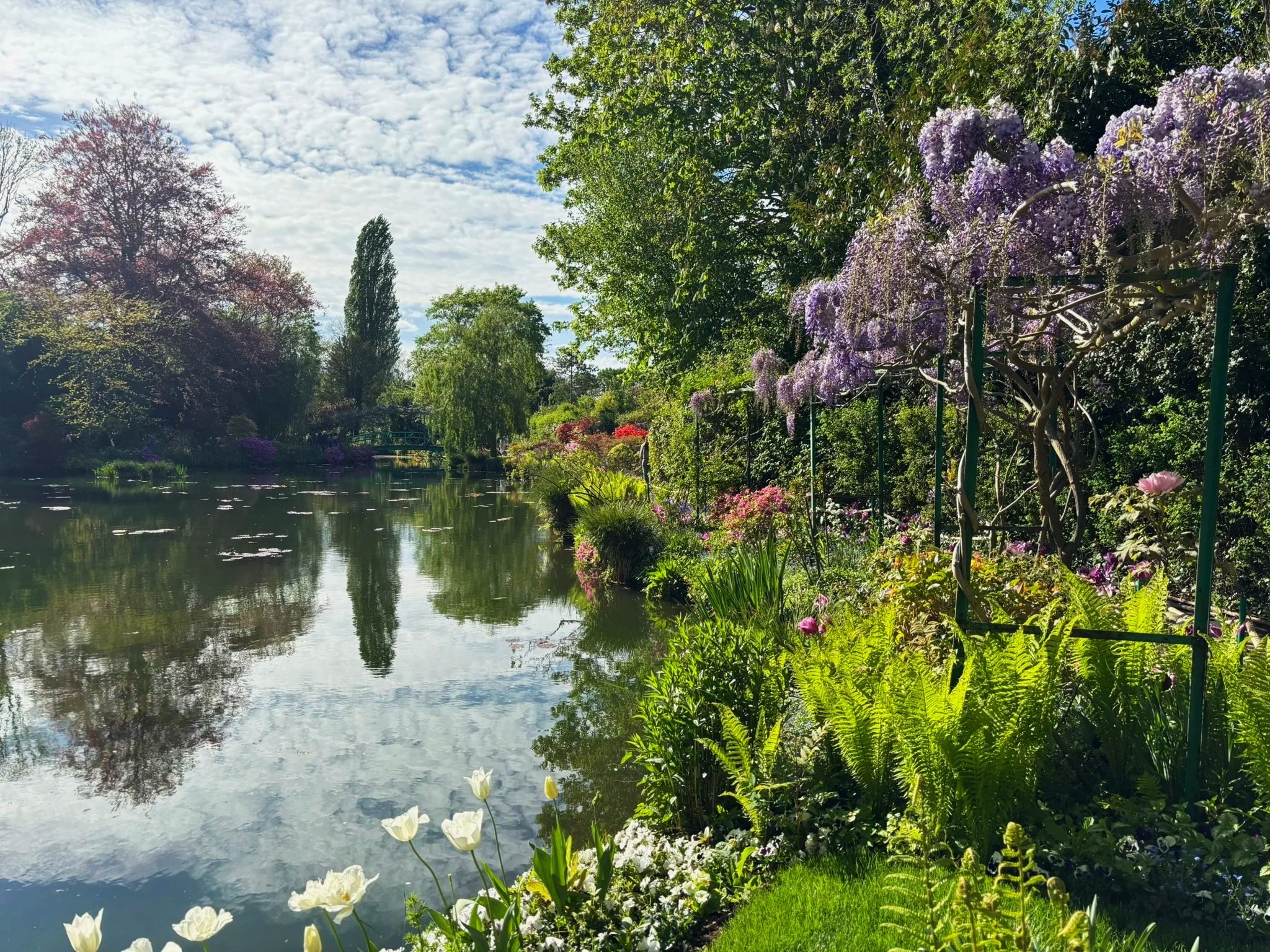
Looking out at Claude Monet’s famed Water Garden, the inspiration for his most famous works, on the property of his former home in Giverny, France
Tuesday, 8:15am — Déjà vu sets in as we wait for our second tour with City Wonders to get underway at the same meeting point that was used for Friday’s excursion to Mont Saint-Michel. The small church at Place du Général Koenig greets us looking just as crusty and ancient as the last time we saw it.
This was it. We had one shot, one opportunity; we couldn’t miss our chance to blow, to seize everything we ever wanted. So we asked ourselves: would we capture it, or just let it slip? Despite our palms being sweaty, knees weak, arms heavy — maybe even a smidge of evidence of mom’s spaghetti — on the surface we were calm and ready to take on our final full day in France. Yep, that just happened.
Also happening on a Tuesday morning in April was one of our final 40-something-minute walks across Paris to once again embark on a cute, not-so-little tour that would see us first to the outskirts of the city for a stop at the Palace of Versailles, and then out to the French countryside for a visit to the former estate of a famed French painter (whose ghost we may or may not encounter a little later (*insert studio audience gasping sound)).
Our second and final extra-Parisian affair began much the same as the first with an early morning rendezvous at that other, much smaller and much more decrepit-looking Notre Dame — Église Notre-Dame de Compassion — in the 17th Arrondissement. We had even booked with the same tour company, City Wonders, but Dee, who had so gracefully and entertainingly guided us out to Mont Saint-Michel the Friday before, was nowhere to be found. In her place was some nondescript person who hardly said “boo”. Fortunately, that forgettable individual was only with us for the short ride to Versailles. Once there, our larger group split into two, pairing off with a couple of on-site guides.
9:22am — Our latest tour guide, Maxim — short for Maximillian — wrangles our half of the group near the gargantuan statue of Louis XIV outside the Palace of Versailles. It’s clear from the outset that he’s going to be a hoot.
After he’d handed out audio guides to everyone, Maxim let us loose for a quick potty break outside the main gates of the palace, allowing us 15 minutes to get ourselves together before heading inside in earnest. Apparently, this was not enough time for one couple in our group, who, after a solid 20 minutes, could be seen lazily sauntering in our direction, armed with just-purchased snacks, as Maxim flailed his arms and implored them to get a move on, fearing we might miss our timed entry slot. Had that happened, it would have been straight to the gallows for those two. But not to fret: we made it inside right on time.
Once inside the palace, it became evident why Maxim was being such a stickler on sticking to the schedule. In case you didn’t know, the Palace of Versailles is a hoppin’ place to be — even on a random Tuesday in April. We’d barely squeezed inside before being surrounded by multiple school groups, several other guided tours, the Little Sisters of the Poor, a cadre of Russian bears on tiny unicycles, and the freakin’ Scottville Clown Band. I mean, was this the Catalina Wine Mixer or what?!
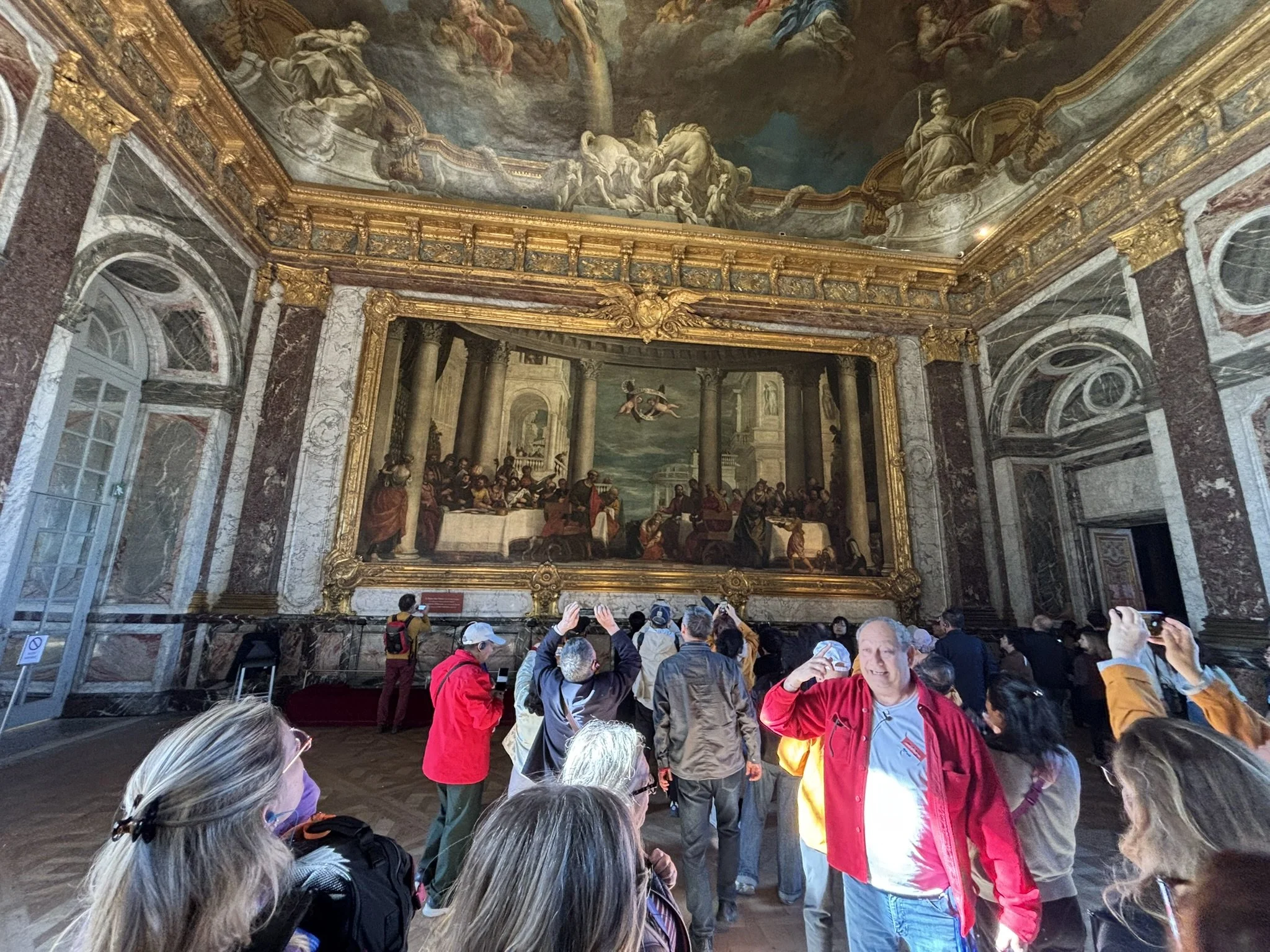
As we walked through the various rooms and chambers adorned in gold, marble, and classical art, Maxim (pictured below, facing the camera in a red jacket and grey T-shirt) did his best to keep us all corralled while running through an abridged version of the palace’s history. It all began, as you know, back in May 1682 when his most righteous Majesty, Louis XIV, pulled the plug on Paris and moved the seat of French government out into the countryside. There, he could avoid the restless and rowdy crowds that might mean him harm in the city, while also keeping an eye (and a thumb) on France’s aristocracy —the Epstein Class of the day, if you will — whom he forced to make the move with him.
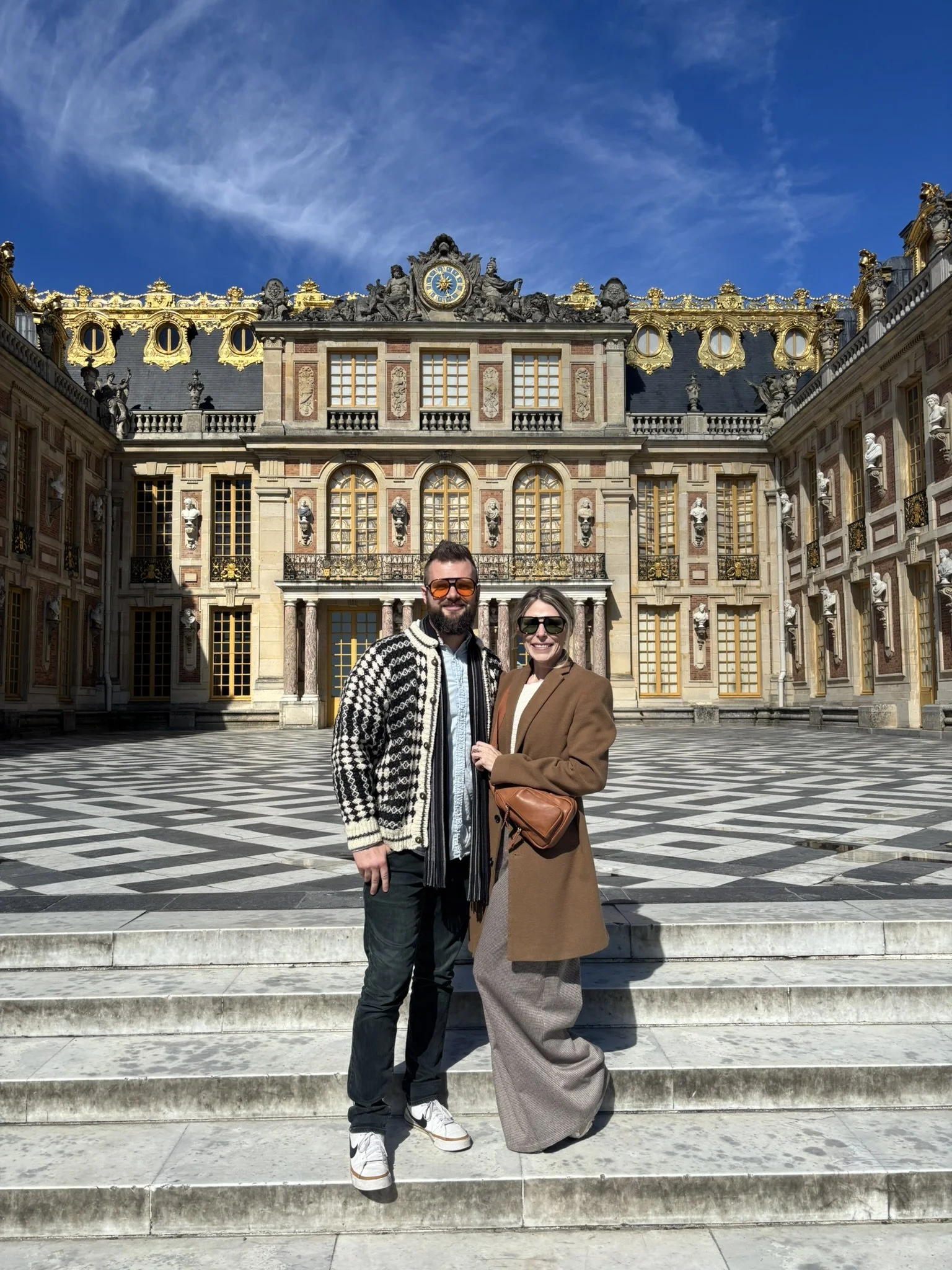
The Palace of Versailles, today an elegant mansion with every trimming imaginable, wasn’t always so palace-y, however. Sixty years before Louis XIV arrived, his father, Louis XIII (never would have guessed that one, would ya?), built a hunting lodge in the middle of the woods, which at the time were ripe with pheasants, boars, stags, and other game. The first iteration of the lodge was apparently fairly ramshackle, as, just seven years after its construction in 1624, Lucky Louis decided to rebuild the place. The new structure was finished in 1634 and would later serve as the basis for the palace that exists today.
Versailles remained a countryside getaway for the crown throughout Louis XIII’s reign from 1610 to 1643. This continued into the earliest years of Louis XIV’s time on the throne, as well, with the young king often finding reason to sneak away from Paris. By the time he moved to Versailles for real, his intention to build the grandest palace in the world was already visible in the form of a number of construction projects. In fact, from the time he took up residence there in 1682 until his death in 1715, some kind of major renovation or another was always underway. Perhaps the most prominent update during his time was the addition of the vaunted Hall of Mirrors along the backside of the palace, which was constructed between 1678 and 1684.
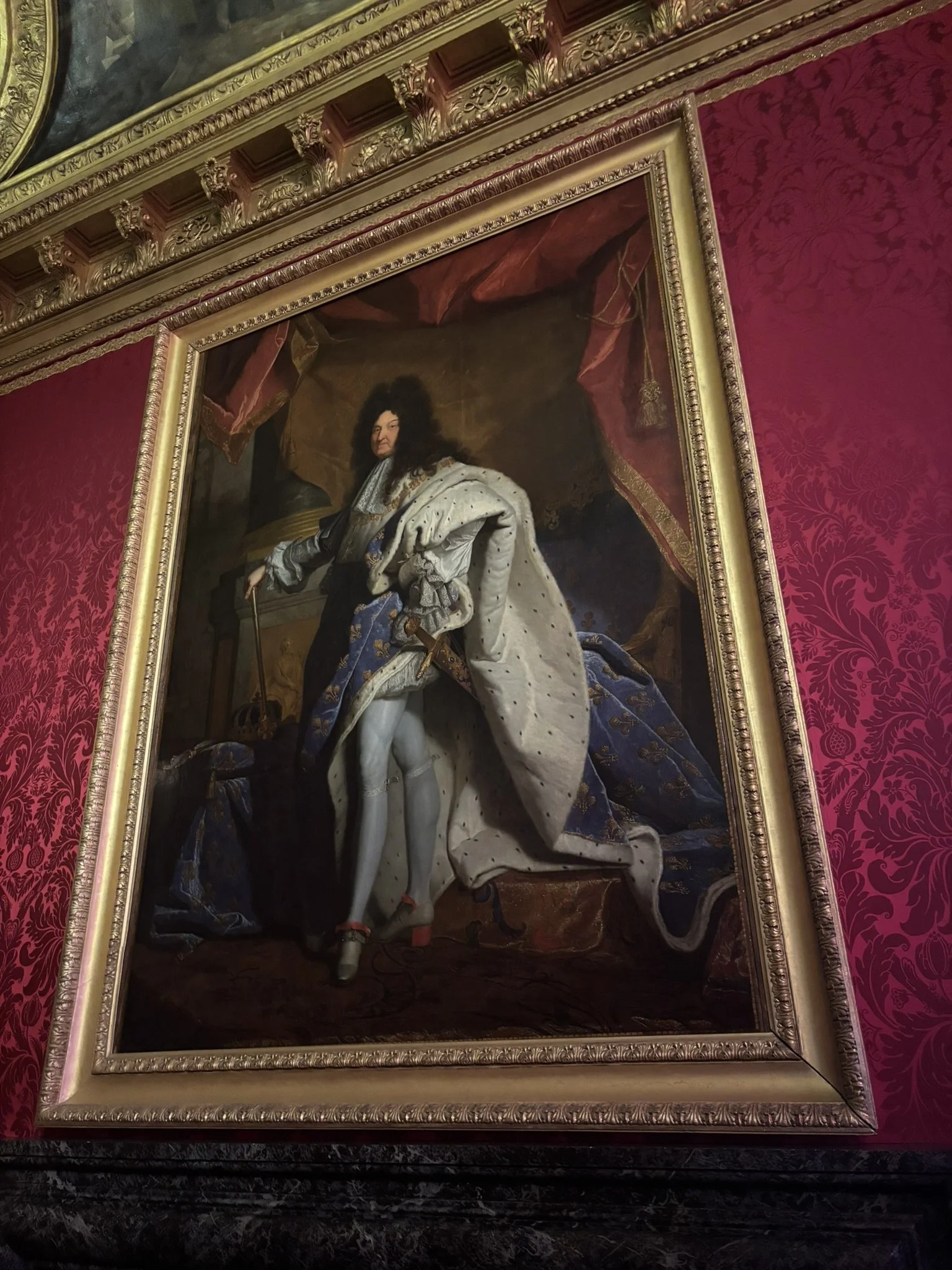
10:43am — Maxim points out a painting of our old pal Louis XIV, which he says was completed later in the king’s life when he was feeble and mostly bedridden. Apparently, he didn’t let that fact stop him from sashaying around in those high heels, though.
11:09am — In what was once her bedroom, Maxim gives us the lowdown on Marie-Antoinette, whose tale is often misconstrued. A woman in our group asks if Marie was a mistress or a wife to the king. Aghast at this individual’s ignorance, we all take turns hitting her over the head with a candelabra.
The French government said au revoir to the palace-in-progress for almost a decade after Louis XIV kicked the bucket, but the circus eventually returned to town in the summer of 1722 at the behest of his 12-year-old great grandson, Louis XV, who had been named king at the ripe old age of five upon the elder Louis’ death. How did a five-year-old take the throne, you ask? No, he didn’t shank all the other would-be heirs by cover of night; rather, four of them died between 1711 and 1714 — one via smallpox, two via measles, and the fourth in a horse riding accident — and the other gave up his right by virtue of his ascension to the Spanish throne in 1700 (waddup, King Philip V!). Alas, Louis XV was the next man …well, child… up. Them’s the rules (*insert shrug emoji).
Louis XV was not nearly as ostentatious as his great grandfather, who enjoyed entertaining nobles and showing off his precious Versailles every opportunity he got. The new Louis, by contrast, was more likely to be found sequestered in smaller chambers smattered throughout the palace, a number of which he added during his time as king. He continued Louis XIV’s big renovation projects, as well, notably overseeing the finishing touches on the palace’s Royal Opera House, but didn’t live full-time at Versailles. He spread the wealth around, in fact, residing variously at Château de Fontainebleau, Marly, and the Palace of Compiègne, among other locations further afield.
But what I’m sure you’re truly eager to hear about is the ill-fated reign of Louis XVI, the monarch who unfortunately found himself on the throne at the outset of the French Revolution in 1789, and his oft-maligned wife, the Archduchess of Austria, Marie-Antoinette. Their wedding, which took place at the Palace of Versailles in May 1770, four years before Louis XVI succeeded his grandfather, was a massive event with celebrations lasting for nearly two weeks. While the nuptials themselves were held at Versailles, the culmination of the festivities took place back in Paris at Place de la Concorde, where a royal fireworks show was set to put a cherry on top of the whole shebang.
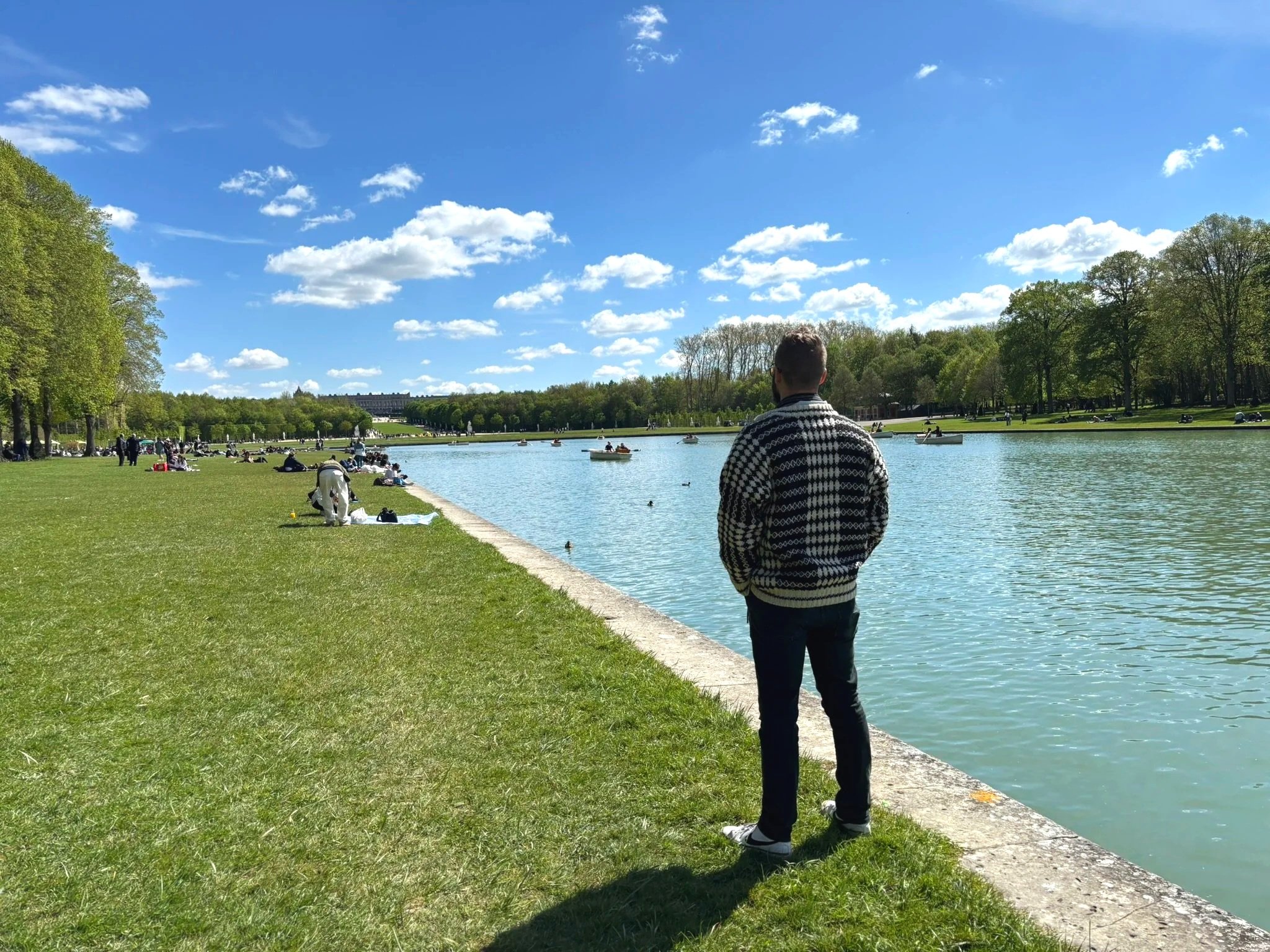
Looking back toward the Palace of Versailles on the edge of the Grand Canal (Photo: Jacquelyn Ahern)
In a sign of things to come, however, the event took a tragic turn. Either a misfire or some other fire-related incident sent the crowd into a frenzy that turned into an all-out panic. By the time the smoke had cleared, at least 132 people had been killed. Some of them died from falling to the ground and being trampled, while others were crushed by makeshift structures in place for the fireworks display that collapsed amid the chaos, and still others fell into the nearby Seine River and drowned. The tragedy wasn’t necessarily an inciting incident for the revolution that would break out 19 years later, but it wasn’t a great look for the French monarchy either.
But back to Versailles! Louis XVI, who was even less a fan of the limelight than his predecessor, loved spending time in the palace, where he made several updates to the interior and whiled away his days studying various subjects in his private quarters and hunting in the surrounding forests. Marie-Antoinette, meanwhile, was quickly becoming a symbol of wealth and opulence directly at odds with the French public, many of whom were poor and starving. The young queen, in fact, was vilified by the people basically from the day she first set foot in France at the age of 14.
11:51am — Into the famous maze of Versailles gardens we go, but only after a word to the wise from Maxim that we will need to sprint to see all 14 of them in time. I half-expect to see Alice or the Red Queen pop out of the hedges as we go, but we don’t even so much as spy the tail of the White Rabbit.
As our punchy tour guide Maxim explained, however, it’s more likely than not that Marie-Antoinette was a convenient scapegoat for the nation’s economic woes. She was a foreigner from France’s (recently-minted) ally Austria but also a prominent face of the French monarchy, and thus an easy target for those looking for someone to pin their problems on.
So, even though she spent less on her luxurious lifestyle than, say, the king’s brothers, and even though France was helping bank roll the American Revolution, which was a major source of their financial predicament, Marie-Antoinette was the one who took the fall in the court of public opinion. A woman blamed for problems caused by unaccountable men — can you imagine?
Nonetheless, the lavish life Louis XVI and Marie-Antoinette led at the Palace of Versailles all came crashing down when an angry mob forced them to leave in October 1789 at the outset of the Revolution. Thereafter, the royal couple were essentially prisoners, living under house arrest at Tuileries Palace, the traditional royal residence that stood next to the Louvre in Paris until it was burned to the ground in the late 19th century. After a fruitless escape attempt in June 1791, known as the Flight to Varennes, the people lost any remaining faith they had in the crown, and it was only a short while later that both the king and queen would meet their untimely demises. The pair were beheaded via guillotine in 1793 — he in January and she in October — as the Revolution roared on. C'est la vie, no?
1:44pm — I once again ask my traveling companion if she would indulge me in taking what she describes as a “glamour shot” next to the Grand Canal. I see her contemplating shoving me into the water, treating the massive fish to a meaty snack. She ultimately decides against it.
After getting a taste of the history of the place and seeing a collection of the main rooms open to the public — including the king’s and queen’s former chambers and the vaunted Hall of Mirrors (pictured below, left) — we made way for the gardens out back. And while the palace, which contains some 2,300 rooms and spans an area of roughly 721,000 square feet, is assuredly an impressive specimen, the 2,000 acres worth of greenery that make up much of the property are an entire world unto themselves.
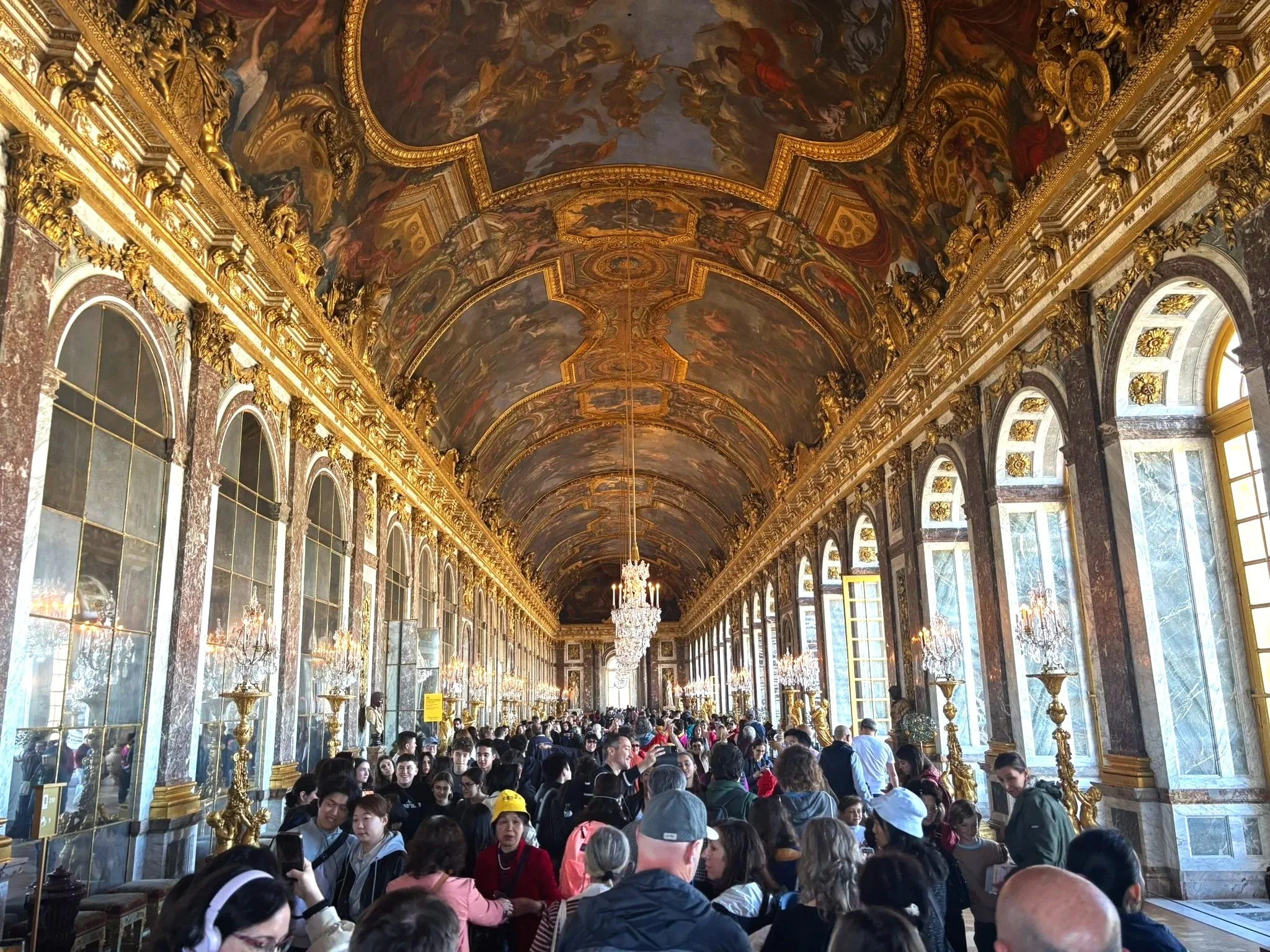
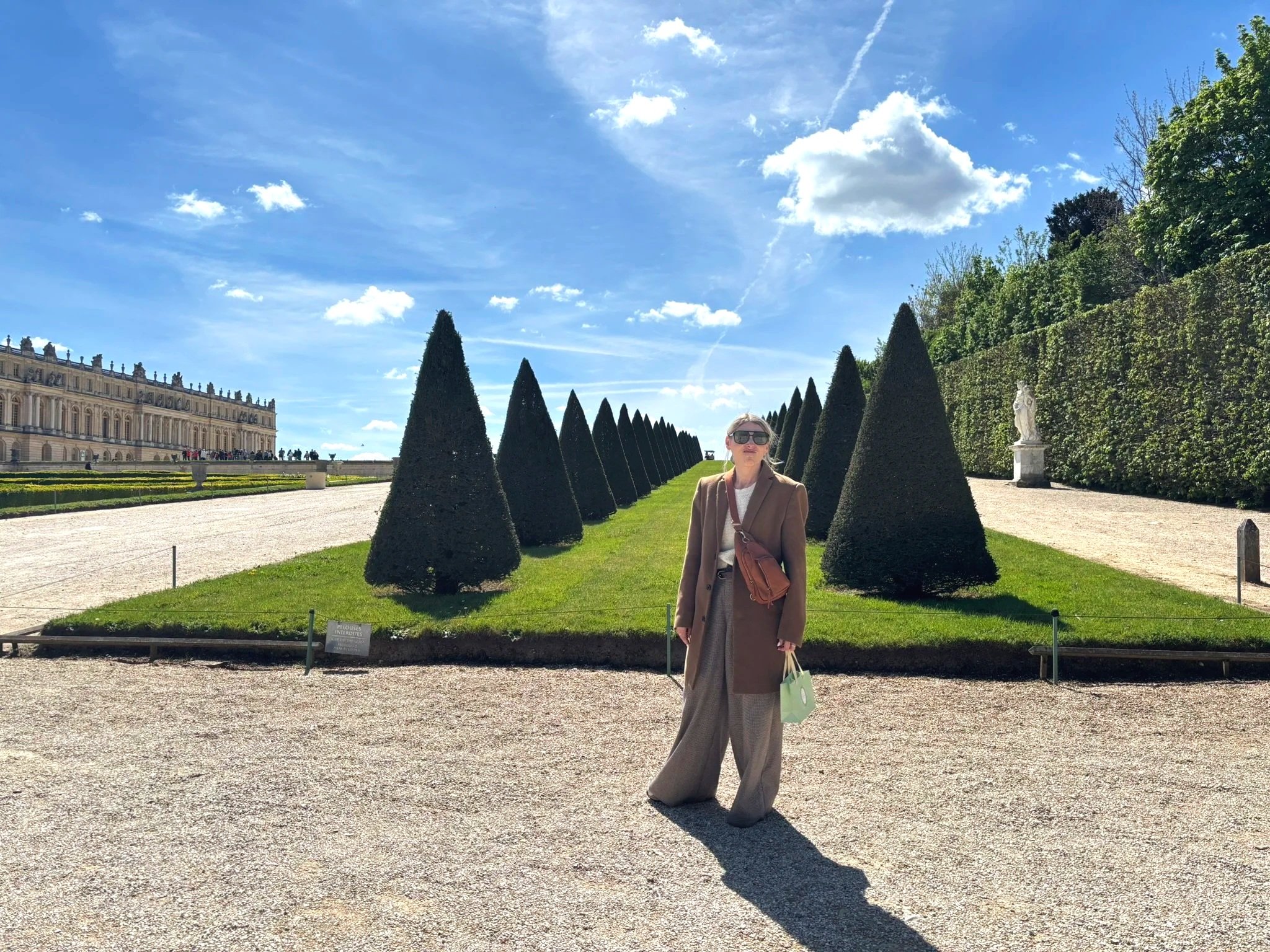
It was plain to see from the jump that Maxim was quite right to warn us about the practical impossibility of seeing all of the Gardens of Versailles in a single afternoon, much less a couple hours. But we gave it as much of a go as we could, strolling through most of the area in between the palace and the Grand Canal before grabbing some lunch. With the tall hedges, the fountains, the statues, and all the rest, it really did feel like stepping into some kind of Carrollian labyrinth where one wrong turn could find you pulling up a chair at the Mad Hatter’s tea party or stumbling upon a group of anthropomorphous playing cards painting the roses red. Although, given this is France we’re talking about, maybe I should have been expecting charismatic candelabras and/or crotchety mantel clocks.
I’m sure you’ve had enough French history by this point, but, if you’ll indulge me, we have to circle back to good ole Louis XIV for just a moment. After all, he was the one who charged André Le Nôtre, the famed French landscape architect, with designing the gardens way back in 1661. The gardens were just as important to the king as the palace itself, so it may not be surprising to learn that it took some 40-odd years for them to be completed in their entirety. The elongated timeline was probably due, in part, to Louis XIV’s decision to review every aspect of the project personally.
Literally thousands of people worked on the gardens over the four-decade construction period, with the king even bringing in entire regiments of soldiers to help out from time to time (a totally responsible use of military manpower, if I do say so myself). The whole thang was designed in such a way that it would need to be replanted once every century. The most recent replanting, in case you were wondering (and even if you weren’t), took place around the turn of the 21st century after a major storm rudely greeted some 10,000 trees on the property on Christmas night in December 1999. Given that many of the trees are therefore fairly young, walking through the gardens these days offers visitors much the same experience that Louis XIV would have had all those years ago when it was all originally planted.
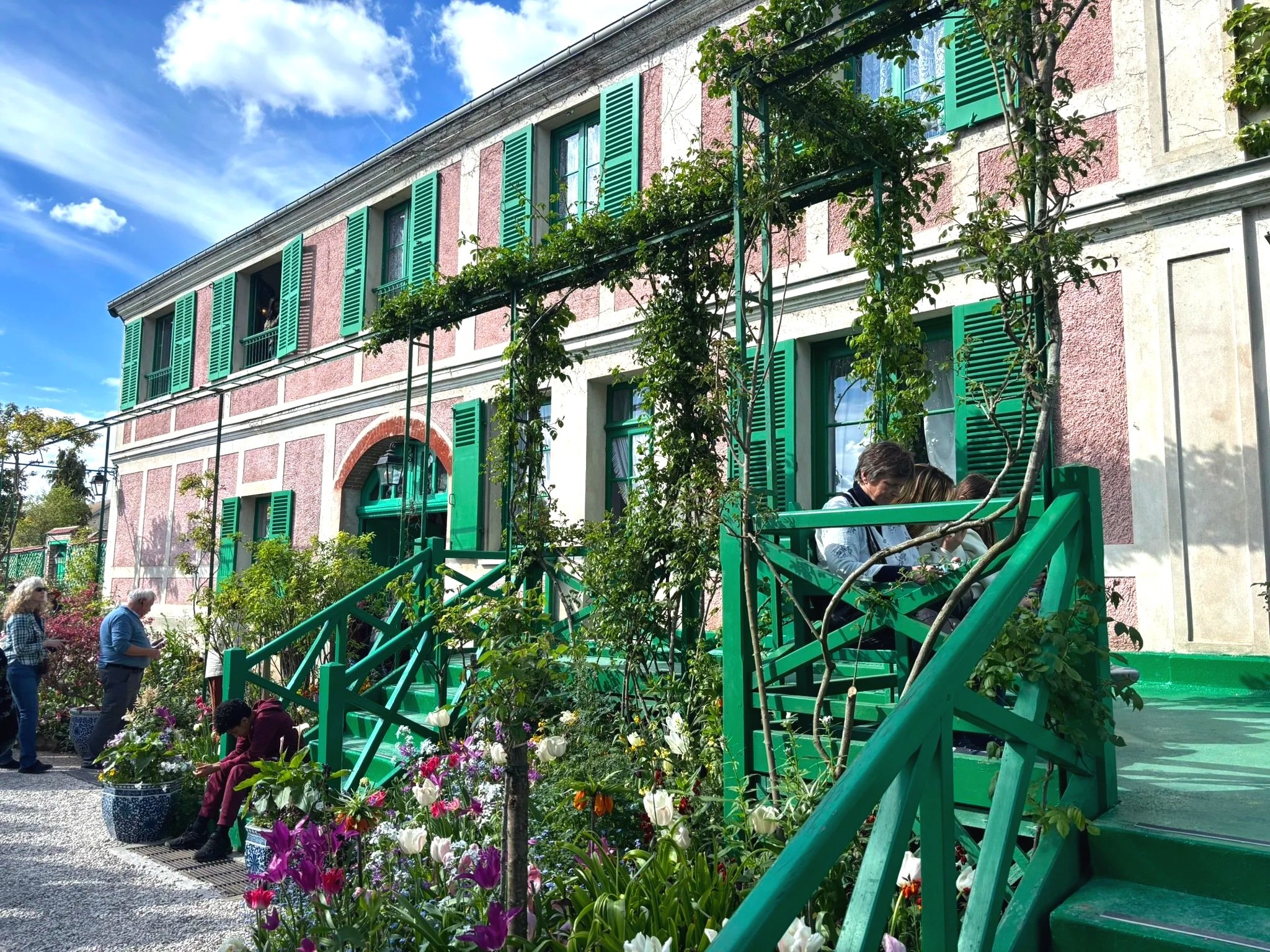
4:24pm — The flowers — red, orange, yellow, purple, pink; every color of the rainbow — surround us as we step foot on the property once belonging to the famed Impressionist painter Claude Monet in the village of Giverny. The bees acknowledge our presence and decide they will allow it — for now.
There is more that could be said about the Gardens of Versailles — including the fact that you can visit for the free during certain times of year and that there are a number of restaurants and shops between the hedges (not literally) to indulge your carnivorous tendencies — but it’s about time we hopped back on the bus and made way for a different French estate: the former home of famed French Impressionist Claude Monet. Found in the small village of Giverny, which is situated about 40 miles northwest of Paris, Monet lived and worked on this property for over 40 years. During that time, he painted a number of his most famous works, such as his Water Lilies series and various versions of the Japanese Footbridge he had installed in his Water Garden.
It’s hard to imagine a more idyllic spot than Monet’s little hideaway in the French countryside. The roughly three-acre property feels sort of like a bed and breakfast that blossomed straight out of a flower-filled fairy tale. From the moment you step foot on the estate, you are surrounded by bright and brilliant colors, from the thousands upon thousands of seasonal blooms — irises, tulips, and peonies (among numerous others) in the spring; dahlias, roses, and marigolds in the summer and fall — to the interior of the house itself, which features a dining room splashed in yellow and a kitchen sporting splendiferous shades of blue.
Getting a glimpse of Monet’s studio when you first enter his former abode is, of course, also a highlight. Ironically, the sunlit space is now filled with replicas of a selection of his many works. The originals, meanwhile, are scattered across the globe, appearing in 80+ museums in a dozen countries. Nearly 200 of these can be found in a trio of museums in Paris — namely, Musée Marmottan Monet, Musée de l'Orangerie, and Musée d'Orsay (which you may remember from an earlier post) — while yet another handful are housed at Musée des Beaux-Arts de Rouen, about an hour’s drive north of Giverny.
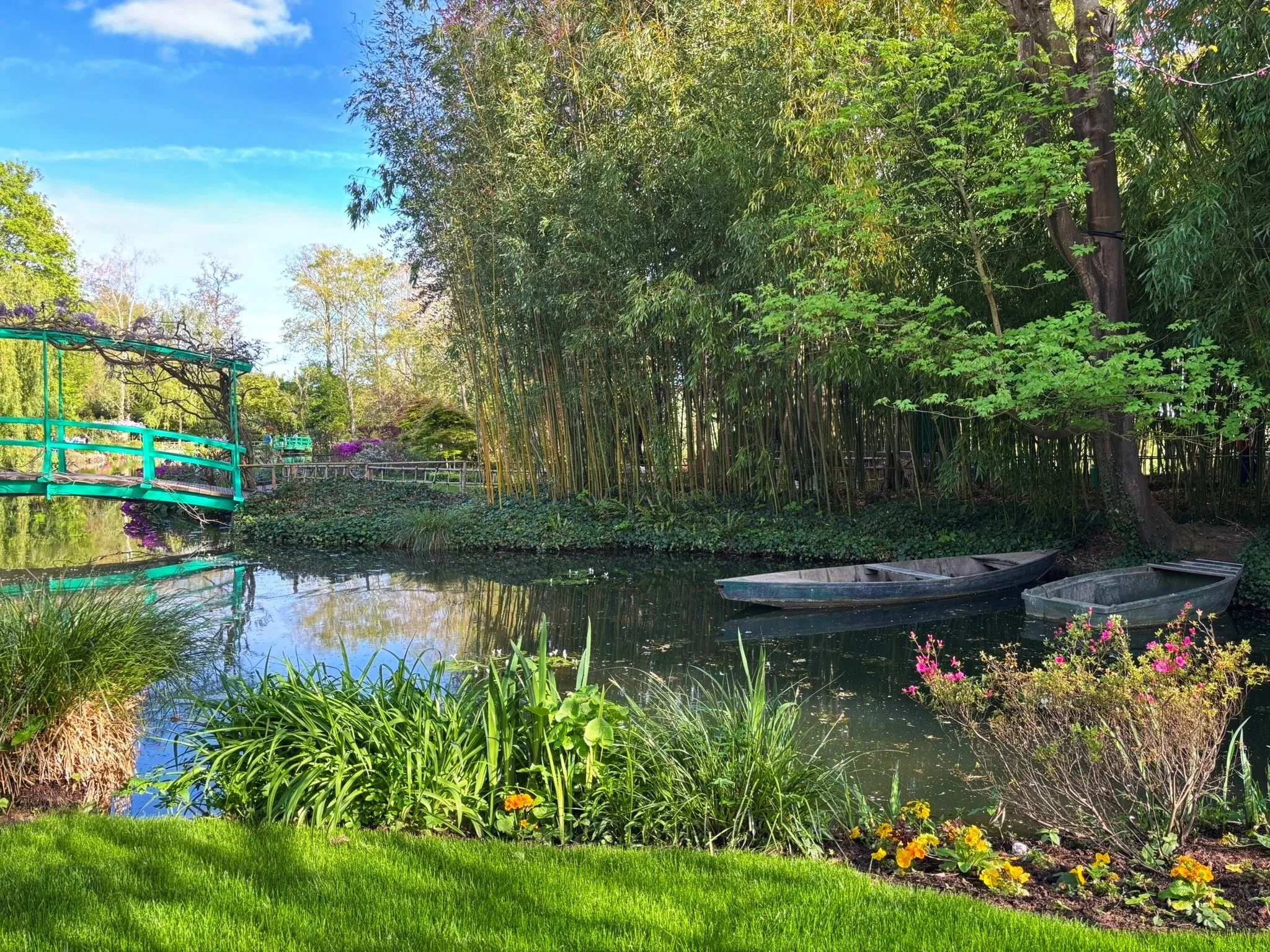
Famous French artist Claude Monet drew inspiration for his most renowned works from the natural scenes found in his Water Garden
5:07pm — I decide to get a few closeups of some flowers resembling the ones that sing to Alice whilst she is shrunk down to size in Wonderland. One of them turns and winks at me, giving me such a fright that I crash through the shrubbery at my back and find myself alone on a solitary cobblestone street. The ghost of Claude Monet appears to my right and asks if he can paint me like one of his French girls. Eyes wide, I clamber to my feet and dive back into the bushes.
6:11pm — We stroll down the village’s main thoroughfare, headed for the graveyard where Mr. Monet is buried next to a small 11th century church along with members of his family. Still scarred from my run-in with his specter only an hour earlier, we try not to linger.
We spent most of our time in Giverny on the grounds of Monet’s estate, communing with the flowers and the bees and the trees and what-have-you, but once we’d had our fill of the famous Impressionist’s former stomping grounds, we journeyed out into the village proper. Giverny, sporting a population of just 400 people spread across 2.5 square miles, may be tiny, but they still have a few spots serving up fine French fare, including La Capucine Giverny, where we grabbed a hard cider and a cappuccino, and Les Terrasses de la Dîme, and more than a handful of boutique hotels. Thus, should you feel compelled to spend a night or two in town rather than partake in a short day trip from Paris, as we did, you’ve got options.
The village overall feels like the kind of small provincial town Belle was trying to escape from in Beauty & the Beast, but, counter to that narrative, it is the kind of place people are generally trying to escape to, not from. That’s exactly what drew Monet there in 1883, in fact, when he first rented the house that would ultimately become his home for the ensuing four decades. It was his escape from city life, a place where he could be inspired by natural beauty and tend to a garden worthy of a million words, coated in a thousand colors.
9:34pm — Exhausted from a long final day, we sit down for our last supper at a brasserie called Le Week End across the street from our hotel. Feeling like going out with some French flare, I dig into roast duck paired with mashed potatoes and a glass of Riesling. I get to use the little French I’ve learned on Duolingo one last time to tell our server that my meal is “très bien!” He smiles politely, likely holding back the urge to smack me across the face and declare, “You know nothing of our ways, foolish American!”
As we lay our heads down one final time in our comfy little room at Hôtel Chavanel back in Paris that night, images of the near-week that had been floated through my mind. From that first sunny day when we’d roamed the streets, glimpsing the Palais Garnier Opera House, the Moulin Rouge, and other landmarks near the eastern end of the Champs-Élysées, to our day-long excursion into the French countryside to take in the magnificence of Mont Saint-Michel; from the centuries-old confines of The Louvre to the rain-slicked heights of the Eiffel Tower; from cruising down the Seine to marveling at the restoration of Notre Dame and getting a taste of French cinema; from concerts inside immaculate churches to the awe-inspiring grandeur of the Palace of Versailles and the quiet tranquility of Monet’s countryside manor — our appetite for adventure had certainly been satisfied.
And so, what is left to say? Perhaps nothing other than …au revoir, mon ami.
-LTH