
Postcards from Paris, No. 2: Glad Tidings from the Tidal Island of Mont Saint-Michel
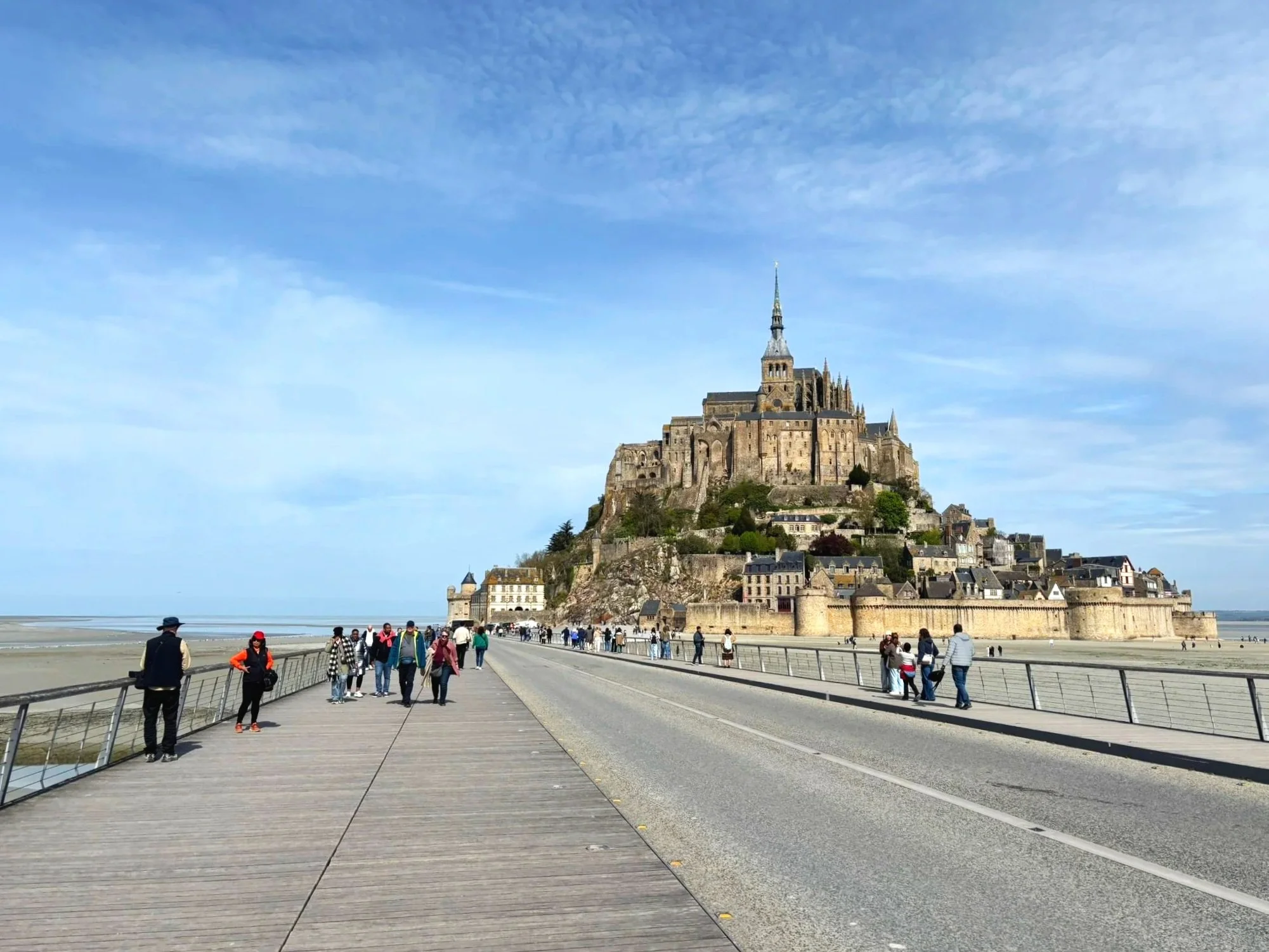
Mont Saint-Michel rises out of the din near the mouth of the Couesnon River in France’s Normandy region
5:00am, Friday — Our simultaneous alarms invite us to arise for what may be the longest day of our trip. I would add something comical here, but it’s difficult to be funny this early in the morning.
After giving ourselves time to settle in on Thursday, Friday came in like a lion, and not necessarily the cute and cuddly kind. While you process that visual, allow me to paint another one: the two of us, my traveling companion and me, walking through the streets of Paris before the sun had even risen, racing across town to meet our tour bus. Could we have ordered an Uber? Found a taxi? Taken a bus? Jumped on the Métro? Perhaps even rented a pair of bikes? Yes, yes, yes, yes, and yes. But did we do any of those things? No! And why not? Because you’re not hardcore, unless you live hardcore.
Seriously, though, from the moment we arrived a little too early to check in at Hôtel Chavanel on Day 1, we determined that our primary mode of transportation while in Paris would be our own two (four) feet. The reason for that was both economical (saving cash money) and aesthetic (what better way to see a city than by strolling its avenues and boulevards yourself?). Factoring in a brisk pace, the walk that morning was a 45-minute hike from our little hub in the 8th Arrondissement, near the Palais Garnier Opera House, all the way over to Église Notre-Dame de Compassion (not that Notre Dame; just hold your horses) in the 17th Arrondissement.
7:01am — Minutes after departing from the meet-up spot, tour guide Dee makes sure everyone is awake with a rousing rendition of “My Heart Will Go On”, complete with backup vocals from Celine herself playing over the speakers. Unless I’m totally kidding.
Do you want to know what the best thing about a 4-hour bus trip through the French countryside is? Not having to drive, that’s what. Thus, after our extremely knowledgeable and equally amiable City Wonders tour guide, Dee, gave us the lowdown on the day’s schedule, I hit an extremely-delayed snooze button in my mind and dozed right off to La La Land — never mind the reading materials I’d brought along.
As you may have surmised based on the title of this post, the destination waiting on the other side of our journey beyond the city limits and across the entirety of France’s Normandy region that morning was none other than Mont Saint-Michel, the Eighth Wonder of the World. All right, I’m kidding about that, but you could be forgiven for believing it! Though not a “World Wonder”, Mont Saint-Michel is a UNSECO World Heritage Site that attracts millions of visitors every year, and it’s not difficult to see why it is the most-visited tourist attraction in France outside of Paris (or so the Internets tell me).
Located on a tidal island near the mouth of the Couesnon River, Mont Saint-Michel’s “modern” history, if we can call it that, dates all the way back to the year 708. As the story goes, that is when the Archangel Michael appeared in dreams to the bishop of the nearby city of Avranches, a man named Aubert who would eventually earn sainthood himself, and instructed him to build a church on top of what was then a rocky islet. Aubert of Avranches, as he was known, refused our pal Miguel not once, but twice. So what did the archangel do in response? Why, he poked a literal hole in Aubert’s head, of course, and that finally kicked the latter’s butt into gear. (FYI: You can check out Saint Aubert’s skull, hole and all, at the Saint-Gervais Basilica in Avranches.)
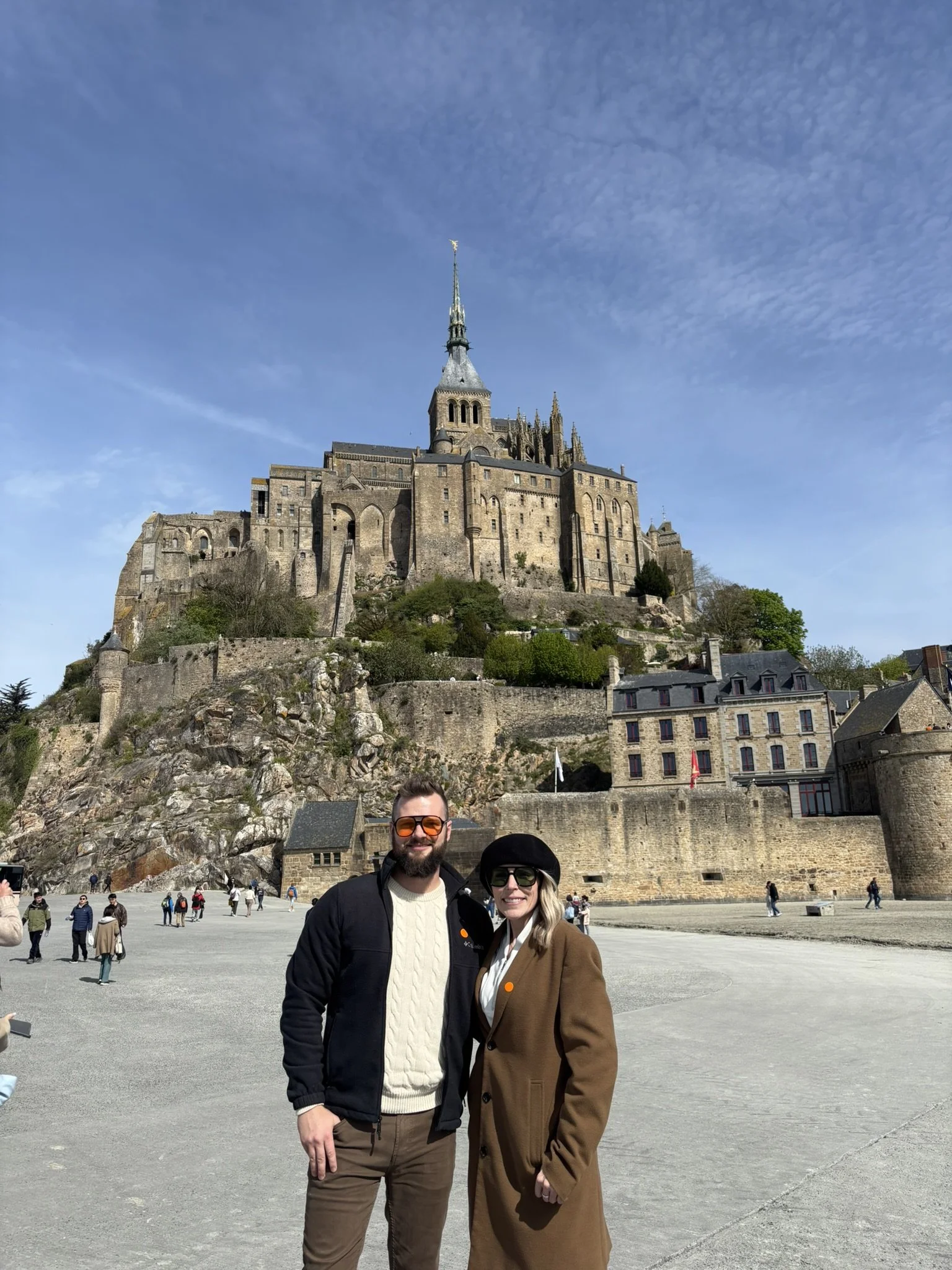
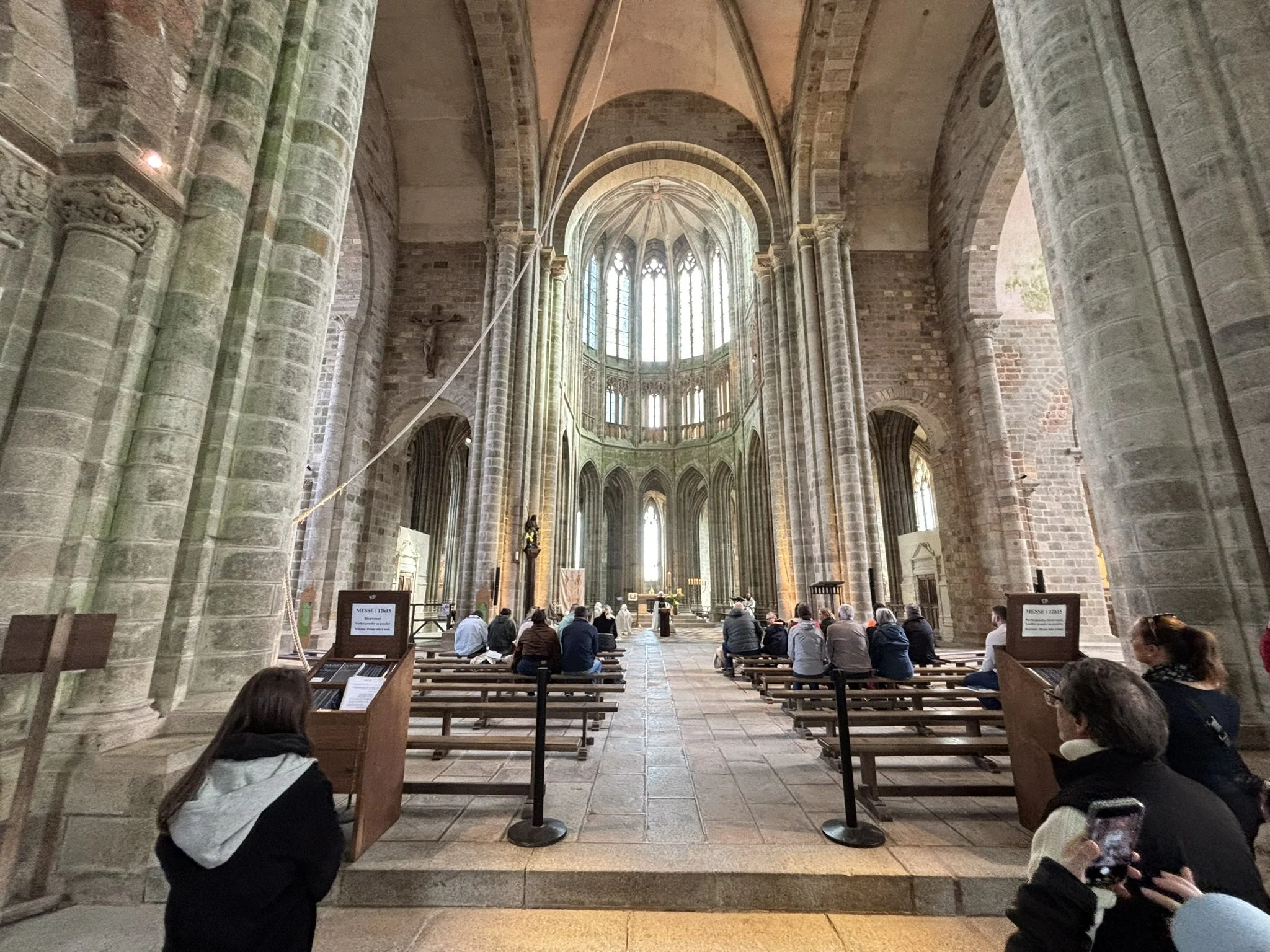
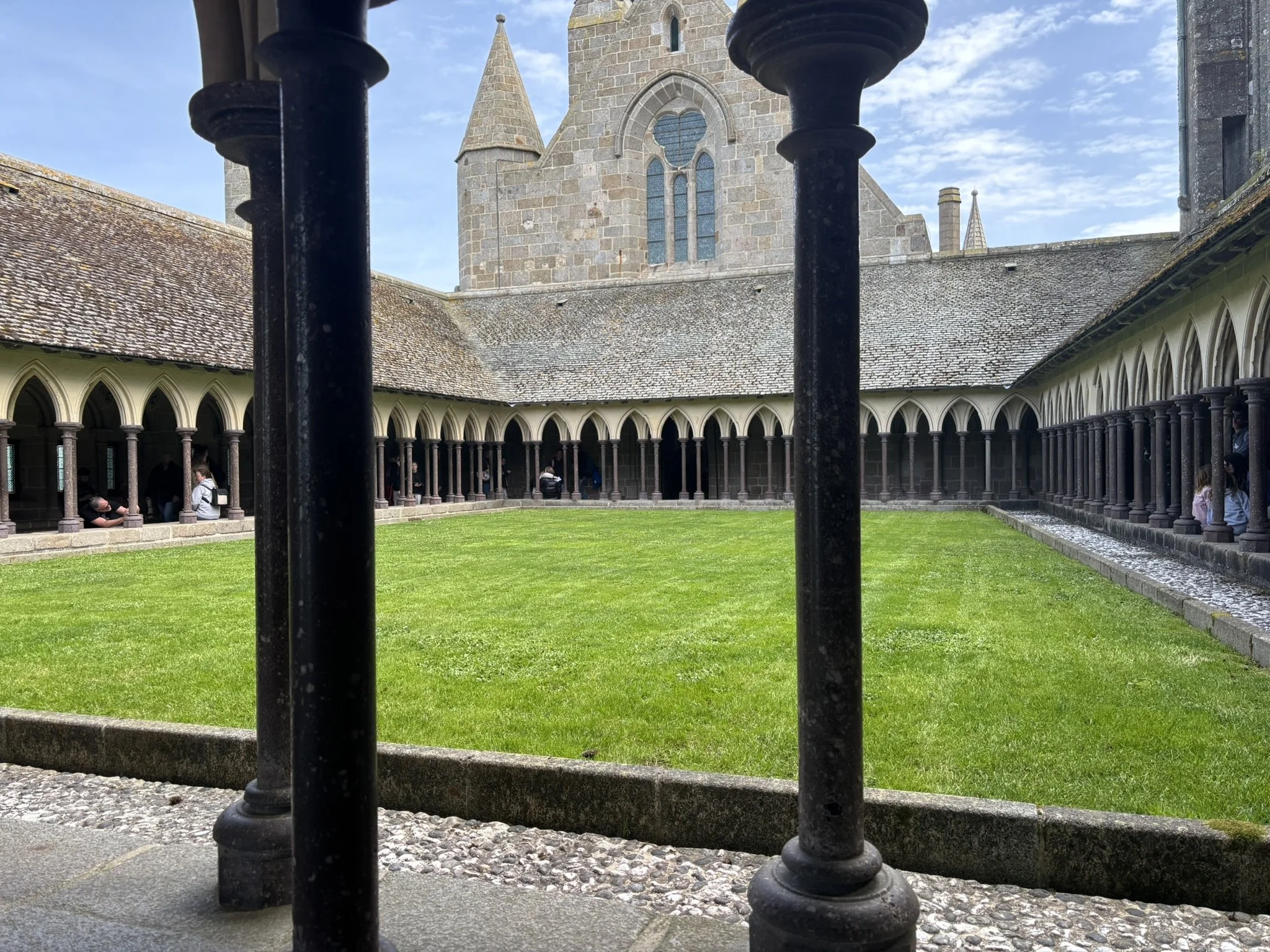
9:38am — Dee regales us with tales of French history as we draw closer to our destination. She quickly assures us that no one will suffer the same fate as Louis XVI once we arrive — as long as everyone remains on their best behavior, that is.
The first structure built on what was then known as Mont Tombe was a small dry-stone sanctuary, or oratory, designed as a replica of an Italian church. Bishop Aubert of Avranches dedicated the place on October 16, 709, instantly transforming the island into a religious pilgrimage hotspot. The first monks to pray and study there, a group of 12 personally sanctioned by Aubert, were big-time fans of Saint Michael, as one might imagine. However, it was the Benedictine monks, who arrived on the scene in 966 thanks to Duke Richard I of Normandy (AKA Richard the Fearless), that oversaw the construction of the first proper church on the mount and really got the party started.
The year 966, in fact, is considered the year that the now-famous abbey atop Mont Saint-Michel was founded, but because things can’t be simple, you have to fast forward nearly a century to the year 1060 to find the origins of the structure you will find there today.
By then, it was Duke Richard II of Normandy (AKA Richard the Good) who was calling the shots. Tricky Dicky the Second selected a mysterious Italian man known as William of Volpiano to design and build the abbey in a Romanesque style. He did just that, placing the center of the cross-shaped church at the very height of the mount. This, apparently, created some architectural headaches, requiring the construction of numerous underground crypts and chapels to deal with weight distribution (don’t ask me to explain that any further, thanks). But by god, Billy the Kid (of Volpiano) made it happen.
11:46am — The Mont that Saint Michael built rises in the west, and Juliet is the east. As we approach, we’re stunned to see armored knights repelling tourists with burning arrows and boiling oil. They clearly failed to provide the secret password.
12:15pm — Diagon Alley… er, I mean, the village at Mont Saint-Michel is alive with the sounds of huffing and puffing visitors. Seriously, did MC Escher build this place?
There is, of course, much, much, much, much, much, much more history concerning Mont Saint-Michel that we could get into — I mean, the place has been around for 1,300+ years, okay? — but if you want to learn more about all of that, you’d probably be better off watching a documentary or, I don’t know, maybe reading a book?
Because I’m sure no one reading these words right now could possibly be interested in the fact that the Benedictine monks threw their support behind William the Conqueror when he decided to head across the English Channel in 1066, ultimately taking out Harold II in the Battle of Hastings and becoming the first Franco-Norman king of England. And, surely, no one perusing these paragraphs would care that Mont Saint-Michel was successfully defended not once, but twice, during the Hundred Years’ War between England and France in the 14th and 15th centuries. Most of all, though, there is absolutely no chance that anyone scanning this page with their eyeballs would give two hoots about the fact that Mont Saint-Michel was used as a prison during the French Revolution (1789-1799) and for decades beyond, which almost assuredly saved the whole place from being torn down over 200 years ago and earned it the nickname “Bastille of the Seas”.
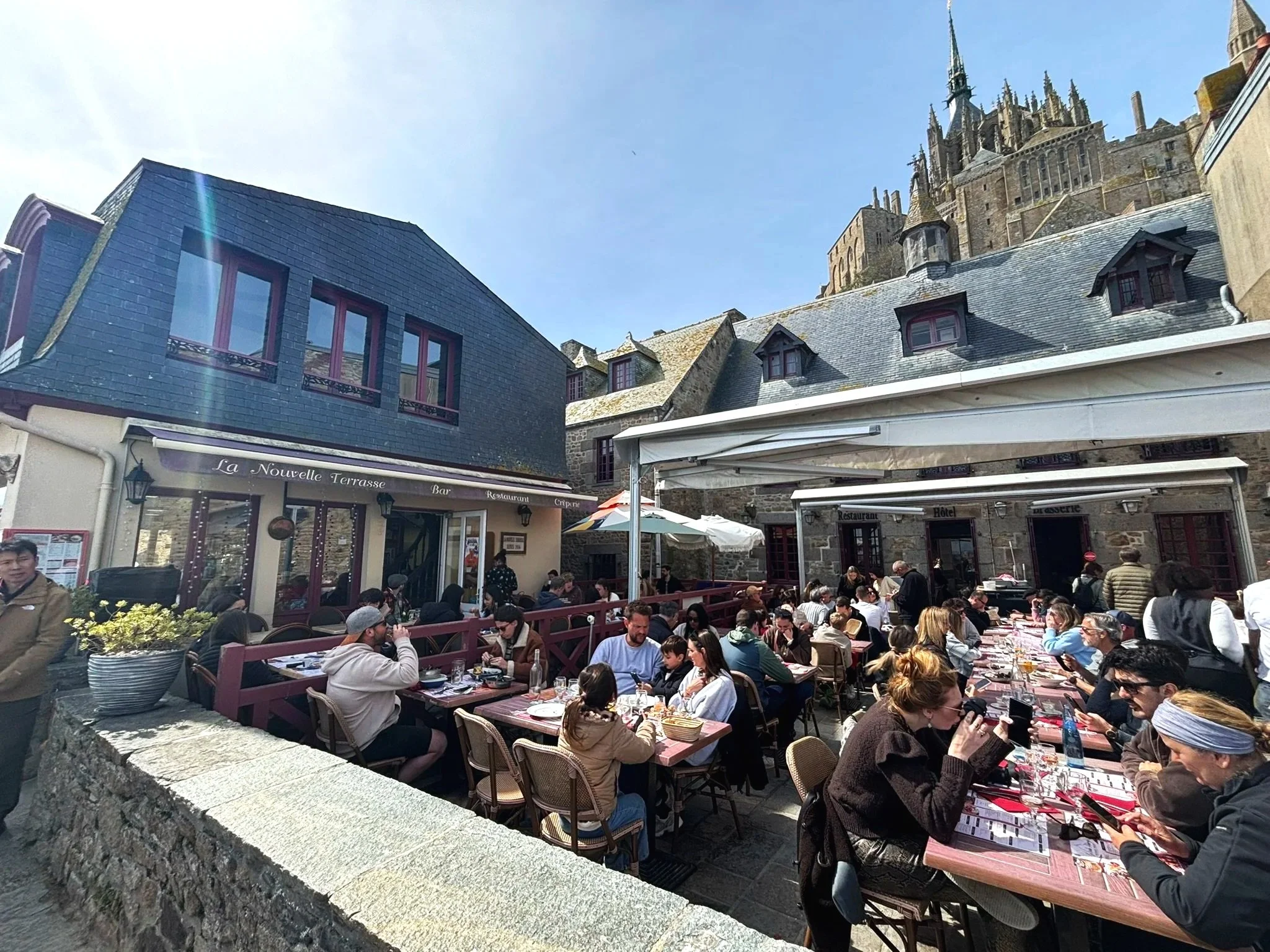
Afternoon vittles are served at La Nouvelle Terrasse at Mont Saint-Michel
No, you’d probably just want to hear about what it was like to be there in person, right? That’s what I’m thinking. So let’s get into that. The most interesting surface-level thing about Mont Saint-Michel is its status as a tidal island. When the tide is low, you can walk right out there on (semi-)dry land, no problem whatsoever. When the tide is high, though, that’s when the mount becomes an actual island, cut off from the mainland by the heightened water level. Haters …uh, I mean, historians… will tell you that the latter scenario — the island truly becoming an island at high tide — is something that only happens infrequently these days.
I know we’re past the history portion, but allow me one more factual nugget in saying that pilgrims looking to get to the island in days long gone by used to literally face the prospect of drowning as they tried to traverse the terrain between the mainland and the mount at high tide.
Nowadays, alterations to the landscape near Mont Saint-Michel have made the trek much safer. A causeway built in the 19th century, followed by a dam constructed in the 20th, have both worked to block sand from being removed by the tides, causing a buildup that has also been buoyed by the stronger tide coming in versus the weaker one going out (ergo, bringing in even more sand that gets left behind). These developments have all but assured that the tide only gets high enough to actually cut the island off from dry land a handful of times in any given year.
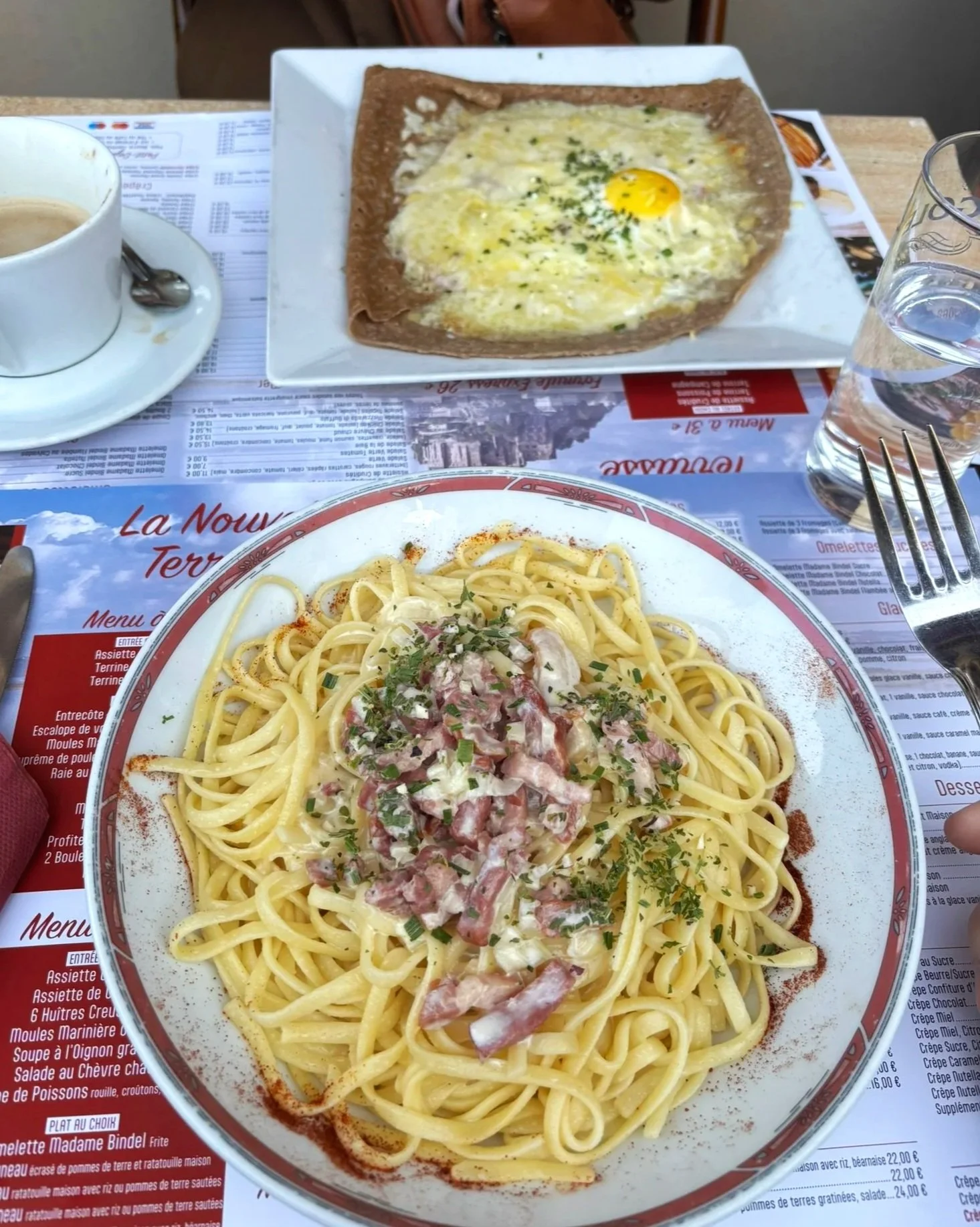
1:48pm — Lunch is served at La Nouvelle Terrasse in the village. The freshly filleted seafood on the plate of the man seated next to us is courteous enough to look over, nod, and say, “Bon appétit!”
We walked around on the mostly-dry land outside the walls of the mount for a little bit, but most of our time was spent exploring the innards of the place (there’s a word for you, huh?). Although there was an audio tour option, my traveling companion and I chose to go without, moving at our own pace. The first area you encounter upon entering gives off major Diagon Alley vibes: a stone pedestrian street beneath our feet, shops and restaurants cloistered close together on either side, banners and pendants and metal signs posted on the walls and hanging overhead. You are continually ascending as you make your way through this little shopping district, gradually gaining elevation until the heavens open up above and your eyes refocus on the ultimate goal: the centuries-old abbey on the top of the mount.
Looking every bit like a castle on a hill (what’s good, Ed Sheeran?), the centuries-old abbey awaits at the top of a set of seemingly never-ending stone steps. But boy, oh boy, it is worth the climb — not only for the majestic views from up high, but also because it feels like you’ve stepped onto the set of some kind of Harry Potter/Game of Thrones/Beauty and the Beast crossover. The interior of the abbey (seen in the middle photo in the triptych above) is impressive enough, but there are all kinds of nooks and crannies to explore, including a host of small chapels, a large dining hall-type space, and various ramparts and green spaces. The journey through all of it takes you up and down, inside and out, back and forth, all while the weight and history of the place hang in the air like a welcome mist (though I’m sure some of the prisoners of yesteryear would disagree).
2:11pm — Already sick of my photo and video requests, my traveling companion shoves me down a steep flight of stone steps. Hopefully she still got the shot.
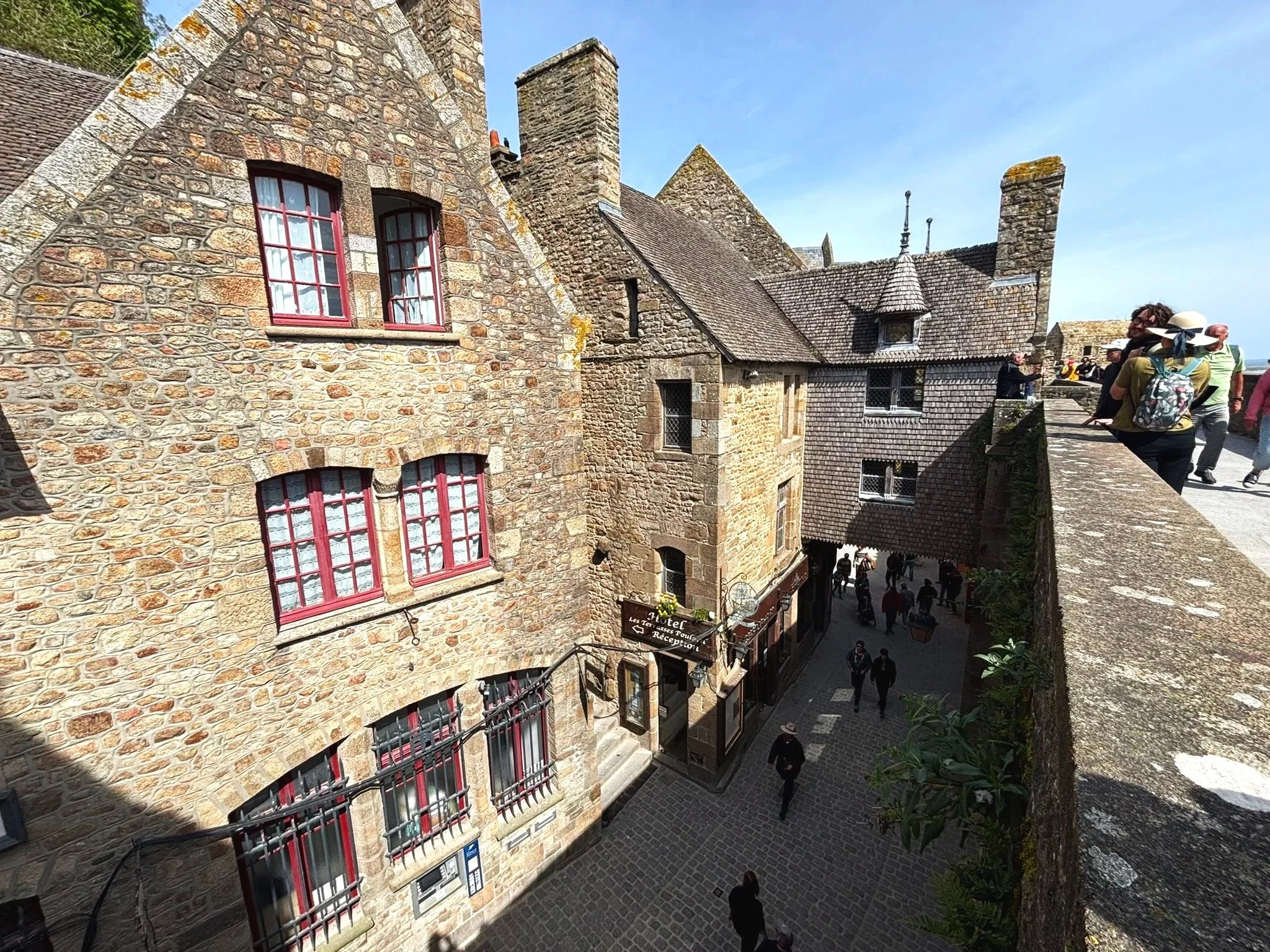
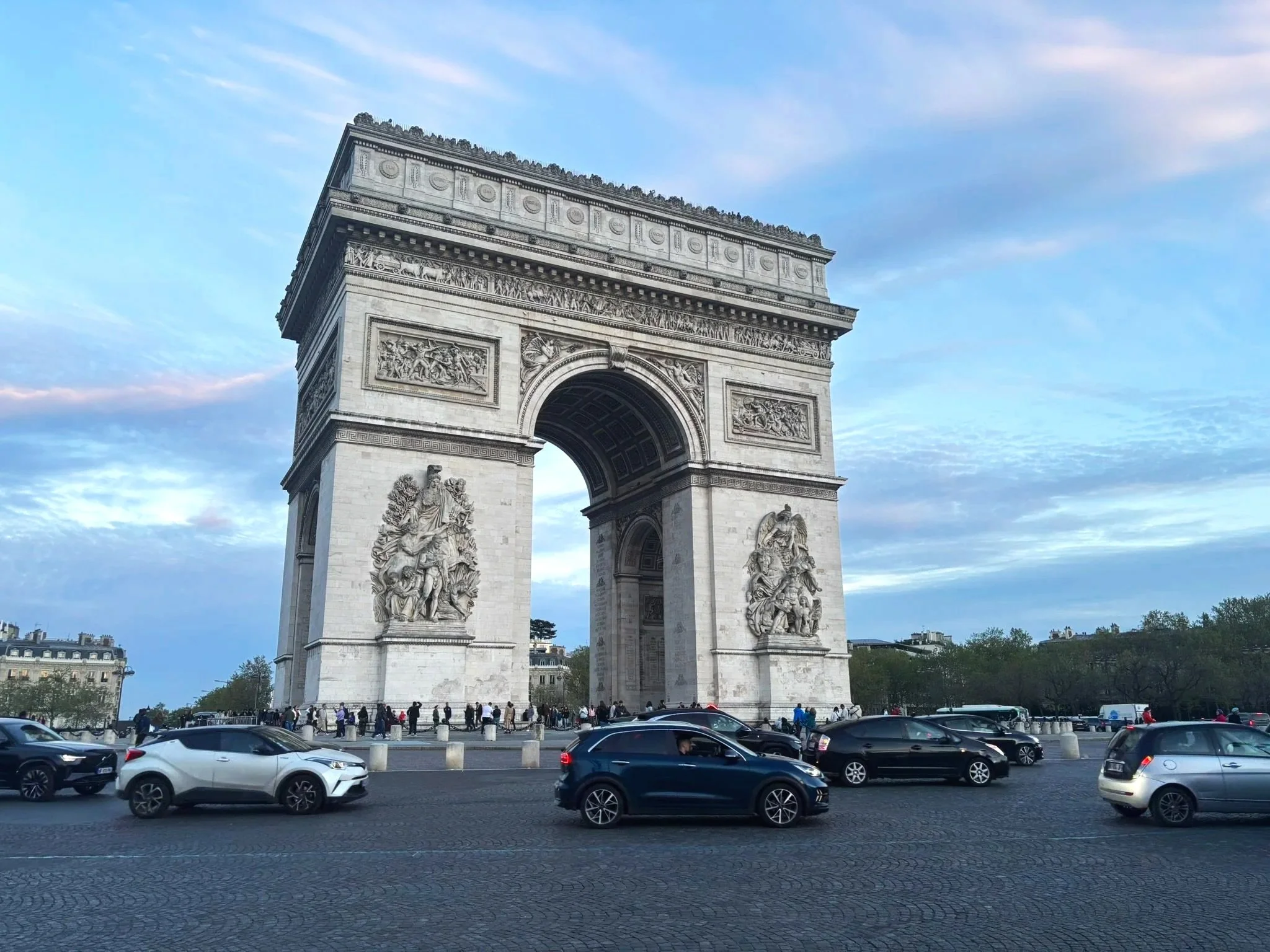
We spent pretty much all of the allotted time we had soaking every bit of it in before making the trek back across the causeway to the parking lot, where our tour bus sat patiently, waiting to return us to Paris. It was already well into the evening by the time we got back, but we weren’t ready to call it a day just yet. Determined to stick to our guns and avoid paying for any kind of public transportation, we set off on foot for the Arc de Triomphe, which stood only a few city blocks from where the bus dropped us off, back near Église Notre-Dame de Compassion.
Commissioned in the summer of 1806 by Napoleon in the wake of his military victory in the Battle of Austerlitz, the Arc, which was designed to honor the soldiers who fought and died in the French Revolution and the Napoleonic Wars, took nearly 30 years to build — a long time, to be sure, but hardly a fraction of the centuries required for Mont Saint-Michel to reach final form (not that we’re pitting them against each other! (or are we?)). It stands now as one of the most recognizable symbols of France, anchoring the western end of the Champs-Élysées.
8:36pm — The Arc de Triomphe rises against a cotton candy-colored evening sky. One night after seeing it from roughly a mile away, here we are, up close and personal. You can’t help but wonder, given its size, if our pal Napoleon was trying to compensate for something.
You can pay to climb up to the top of the Arc, if you fancy, but we had already had such a long day, we were content just to lay eyes on the sucker. The dinner bell rang soon after. I would tell you where we sat down for vittles (food, to the lay person), but my traveling companion may or may not have spotted Remy and his brother inside the restaurant, and they weren’t exactly aiding the chefs in the kitchen, ya feel?
-LTH