
Postcards from Paris, No. 4: A Lazy Sunday on the Seine? You d'Orsay!
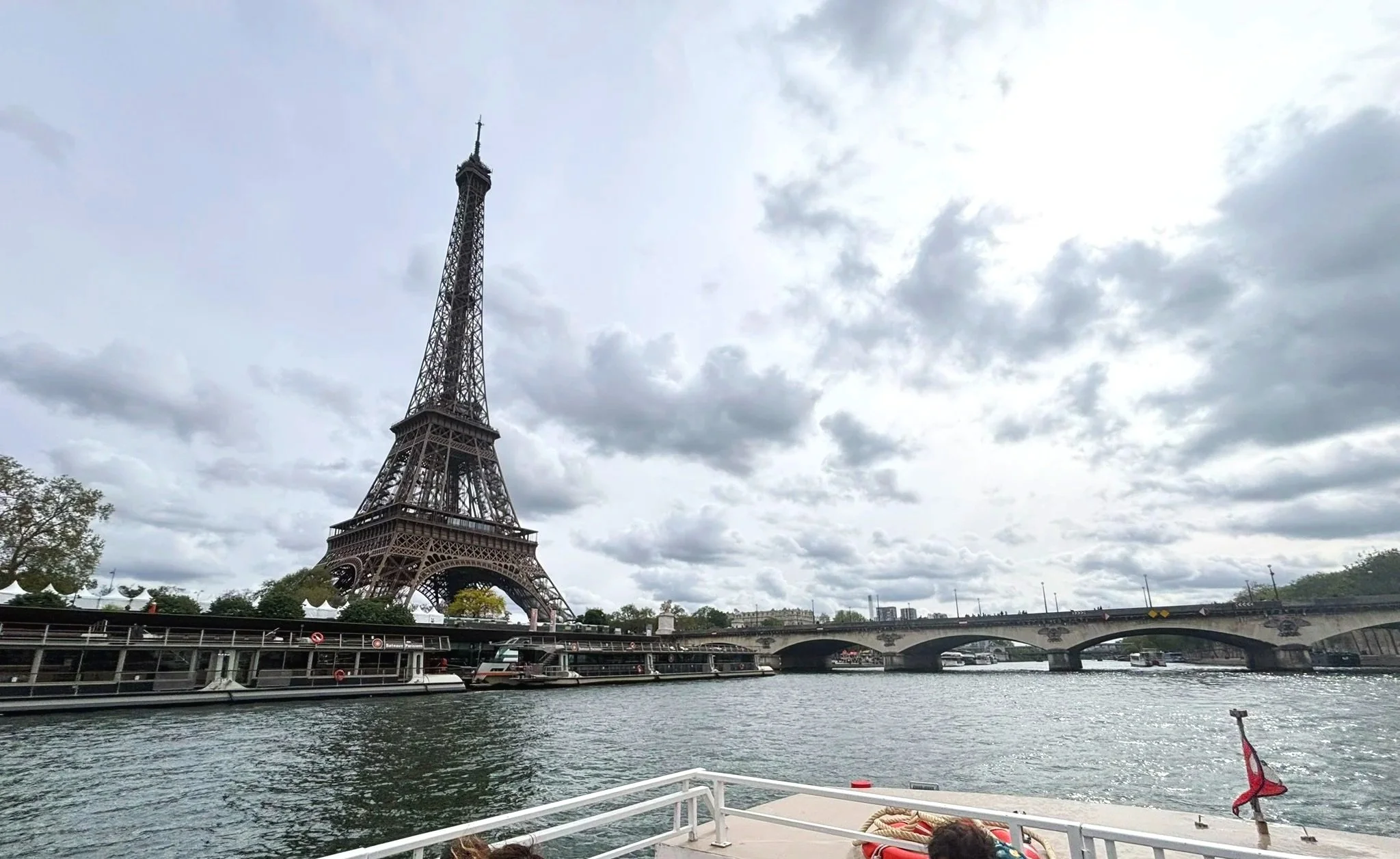
Gustave Eiffel’s Tower watches over the Seine River on a cloudy Sunday in April 2026
Sunday, 9:01am — On our way to another famous Paris museum, a marathon materializes in the street, temporarily blocking the way. But what’s that? An opening across the race path? We zip through the throng, avoiding the incoming runners, much like young Simba in the middle of a wildebeest stampede.
It may have been Sunday morning, but we had no plans to take it easy. In fact, we instead made our way downtown, walking fast, faces pass(ing) — we were museum-bound. Staring blankly ahead, just making our way, making any way, through the crowd …to get to Musee d’Orsay, another one of Paris’ fine art institutions. However, now that the Vanessa Carlton/Terry Crews tribute is in the books, I do have to come clean and admit that the museum isn’t exactly “downtown”. Paris doesn’t exactly have one of those, in fact. Rather, it contains a collection of arrondissements (see: districts or neighborhoods), each one a character unto itself.
Musee d’Orsay is located in the city’s 7th Arrondissement, which also happens to be home to the crown jewel of Paris itself, the Eiffel Tower. After old Iron Sides, though, the museum is probably the second most-famous site in this part of town. If our tour boat guide, whom we’ll meet a little later in this post, is to be believed, Musee d’Orsay is even the preferred art museum of Parisians themselves, most of whom apparently scoff at the overcrowded Louvre.
The two museums sit nearly directly across from one another on the banks of the Seine River, but the Louvre pulls in upwards of 8 to 9 million visitors annually, while d’Orsay is more in the range of 3.5 to 4 million. So if you want to make like the Parisians do and visit a space that’s a little less crowded while still soaking in some amazing art and culture, you know where to go.
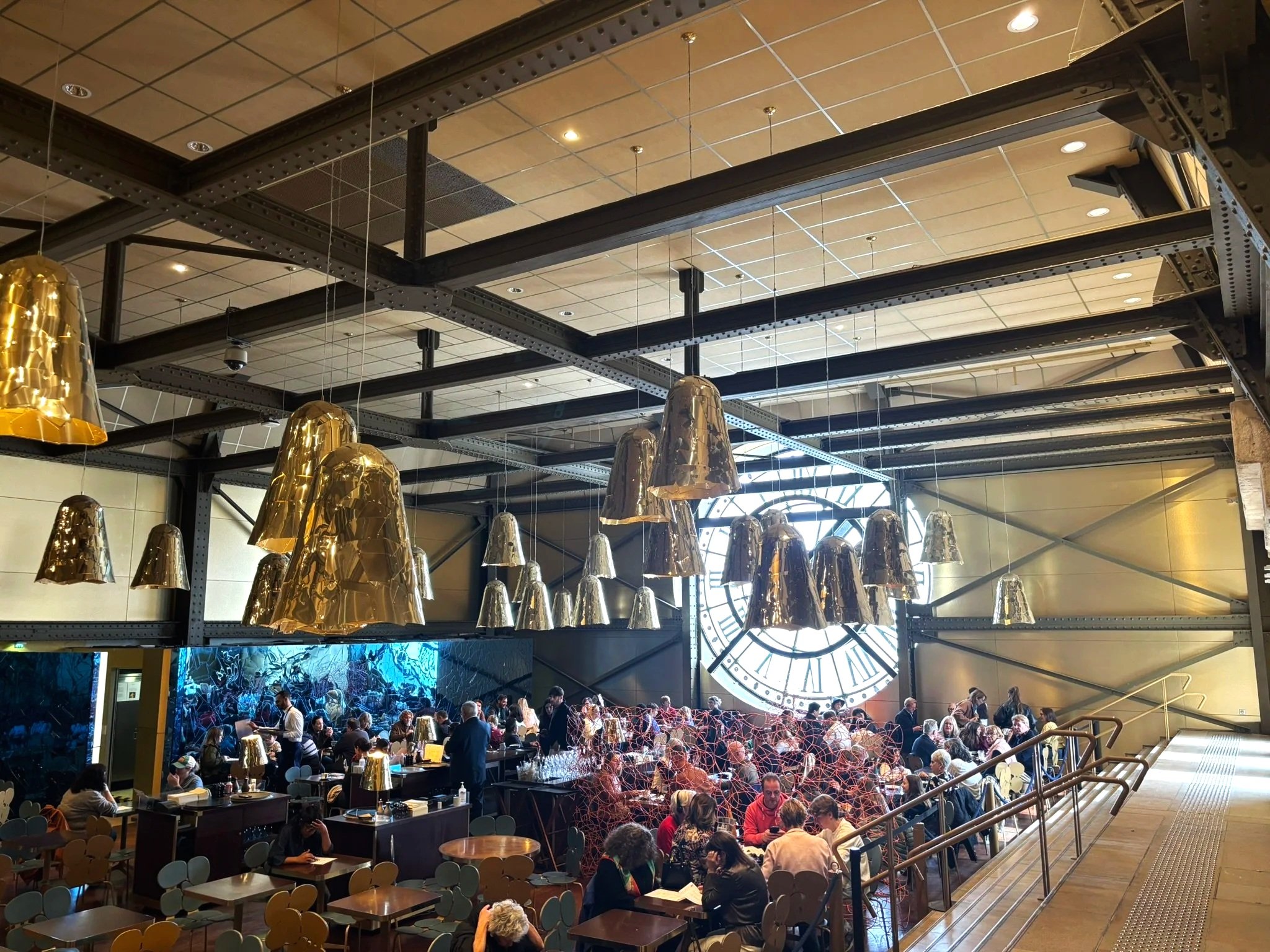
But, aside from avoiding pesky tourists (or, even worse, Americans) why do the inhabitants of the City of Light allegedly love Musee d’Orsay so much? It could be the fact that it’s housed inside the former Gare d’Orsay, a Beaux-Arts style train station and luxury hotel completed in 1900 which unfortunately had a fairly short shelf-life. Gare d’Orsay closed to long-distance mainline passenger travel in the ‘30s and was completely defunct as a train station in any sense by the ‘70s. In the latter half of that decade, plans to transform the cavernous space into an art museum took shape. After extensive renovations, it would eventually open to the public in December 1986.
1:29pm — In a neighborhood slightly further afield, we order a burger to split, sans gluten. Our server gives us a look that says, “Are you f*cking serious?”
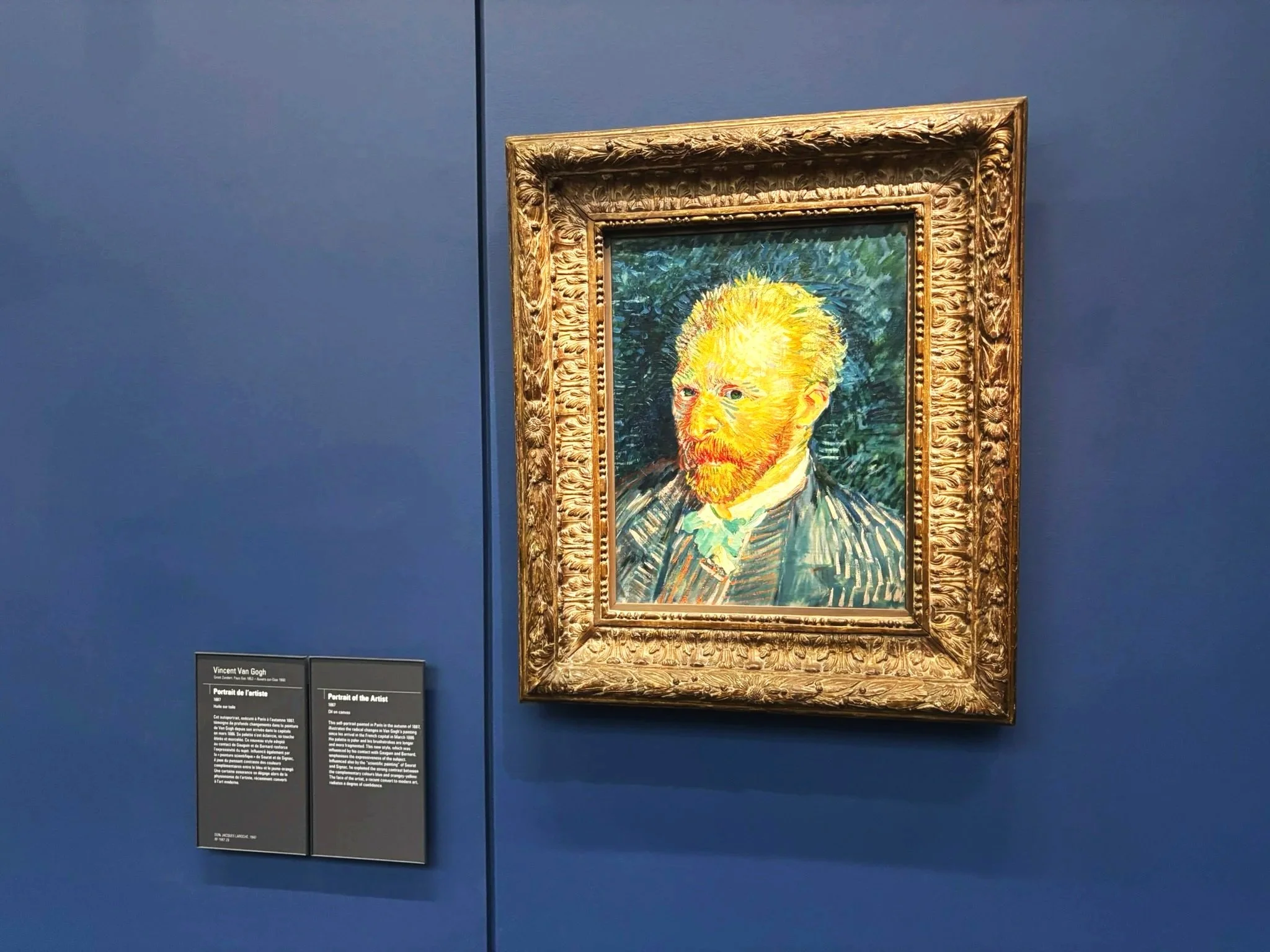
For those Parisians who don’t give a flying you-know-what about the history of the building, perhaps the draw has more to do with the collection housed inside. Musee d’Orsay has a more “modern” collection than the Louvre, including a multitude of pieces from the Impressionist (late 19th century) and Post-Impressionist (late 19th to early 20th) periods. Works by Claude Monet, Pierre-Auguste Renoir, Vincent van Gogh, and Georges Seurat? Yeah, they’re all here, including Monet’s Coquelicots (Poppies), completed in 1873, and van Gogh’s La Nuit étoilée (Starry Night Over the Rhône), which he finished in 1888. (He would paint the Starry Night that most are familiar with a few months later in June 1889.)
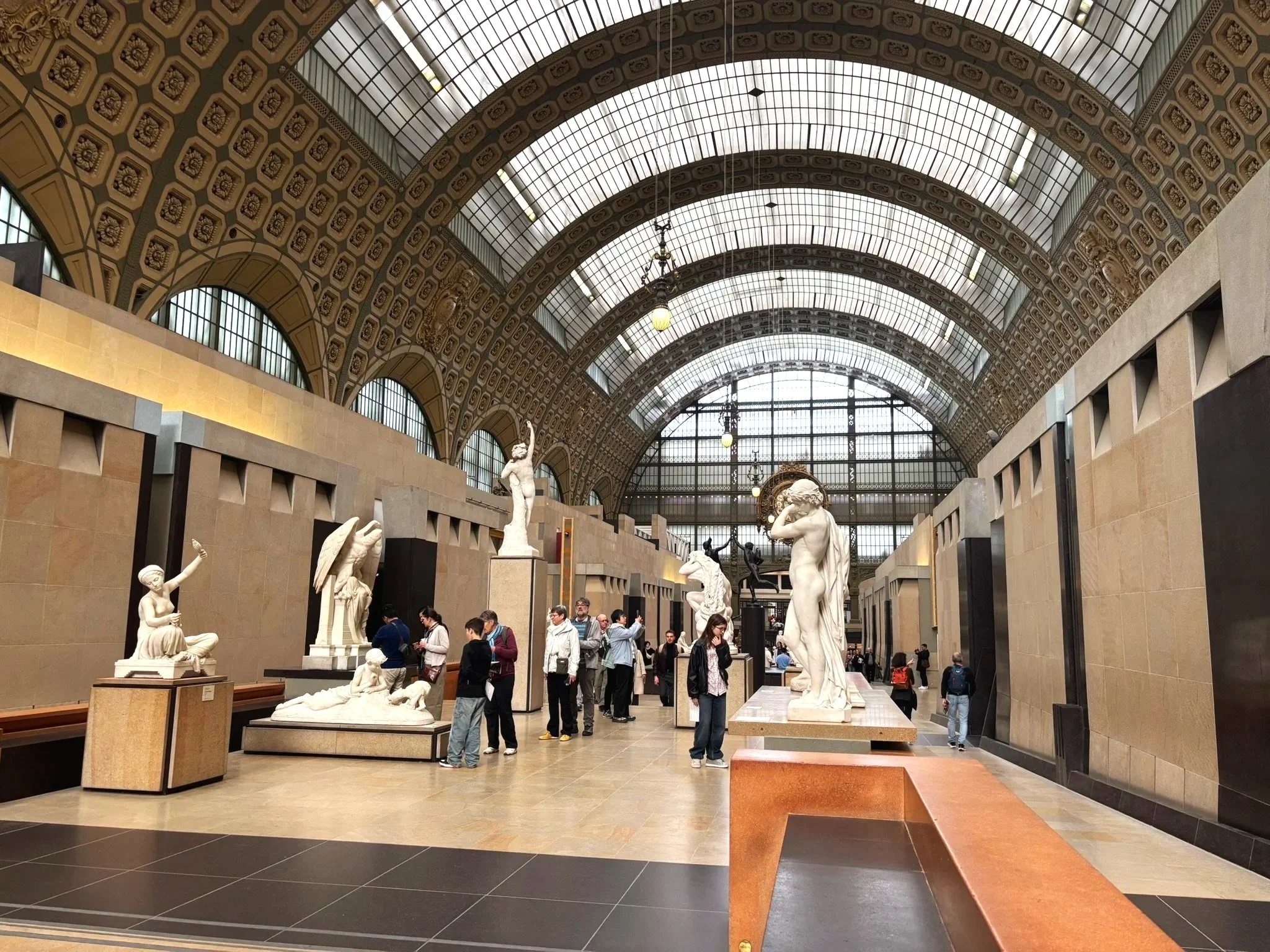
Musee d’Orsay also has a fine selection of fairly famous sculptures, including several by the French sculptor Auguste Rodin. A cast of one of his most famous — and most controversial — pieces, called The Gates of Hell, which Rodin worked on over a period of nearly 40 years from 1880 until he kicked the can in 1917, and never actually finished, is permanently displayed in the museum’s main hall. But it is certainly not alone, as the museum has an inventory of over 2,000 sculptures, with 600 or so typically on display at any given time.
Once we had soaked up all of the art we could handle, we began an hour-long walk heading northeast into the heart of the 10th Arrondissement, where we were slated to meet our tour boat along the Canal Saint-Martin. Breaking up the walk a bit, we made two pit stops along the way. The first was at Bistrot Renaissance for a quick bite (the aforementioned burger that we shared) and the second was at a pop-up street market just off Boulevard de Magenta.
2:27pm — We happen upon a street market filled with vendors proffering vintage clothing and all manner of odds and ends. A man selling watches notices my gaze and says something in French. I pull out my best Mitchell from Modern Family impression and hope he buys it.
3:00pm — As we wait for our canal/river cruise to commence, a gentleman armed with a portable speaker dances his heart out on a pedestrian bridge. Our tour guide remarks that he’s got some sick moves.
Our mid-afternoon excursion on the Canal Saint-Martin and Seine River got underway shortly after 3 p.m. The cruise, which we’d found on TripAdvisor some weeks before, first saw us through a couple of locks in the canal before we went fully underground in a massive tunnel beneath the streets of Paris and eventually into the Seine. All the while, our tour guide, whose name escapes me — let’s call her “Claudette” because that feels appropriately French — gave us the lowdown on everything we were seeing, in both English and French. It became apparent very early on that Claudette had a certain affinity for the phrase “just so you know…” when describing things in English.
Once we’d navigated the canal portion of the cruise, we got spit out into the Seine across from Jardin des Plantes. We headed west on the river from there, passing by Île Saint-Louis, a small island that’s home to one of the richest and most exclusive neighborhoods in Paris; the Cathédrale Notre-Dame de Paris (yes, that one); our old friends, the Louvre and Musee d’Orsay; Place de la Concorde (a callback to Day 1!); and plenty of other landmarks, until we found ourselves face to face once again with the Eiffel Tower.
4:24pm — The captain steers us around to face Paris’ (smaller) version of the Statue of Liberty. Tour guide Claudette gets cheeky: “Just so you know, we generously gave the U.S. a much bigger one.”
At that point, someone apparently got in trouble up on the ship’s bridge, forcing the captain to carry out his threat of “turning this boat around". We swung back to the east, ultimately disembarking on the north side of Île de la Cité, another island in the middle of the Seine upon which Notre Dame sits. That made our next destination a fairly obvious one; no sense in fighting fate, right?
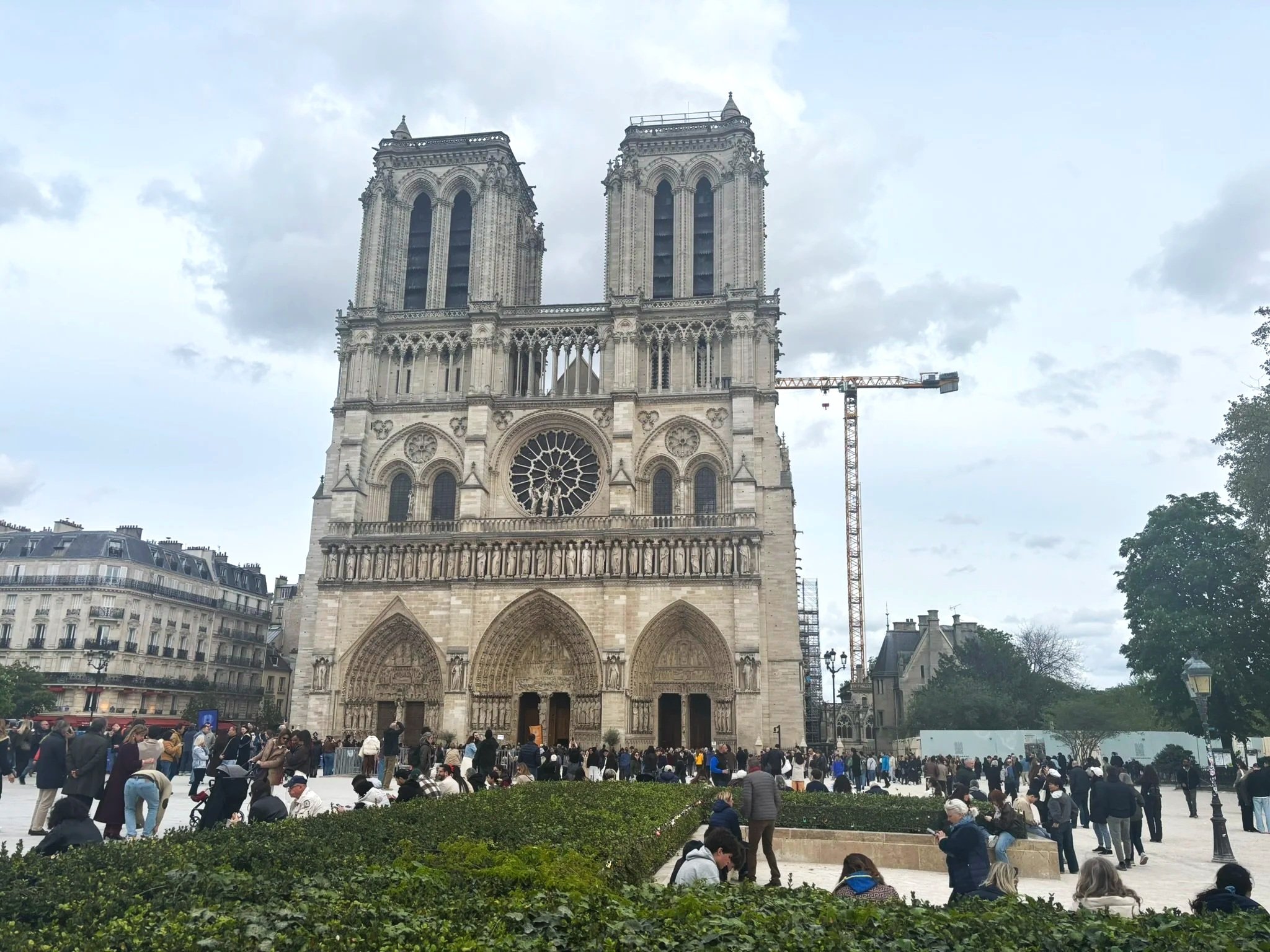
Notre Dame, which suffered heavy damage from a fire in April 2019, reopened to the public after extensive repairs and renovations on Dec. 7, 2024
The square outside the recently reopened Medieval cathedral was humming with activity. There were people in line waiting to get a look inside; others sitting and talking, taking in all the sights and sounds; and still others simply wandering about. After taking a few photos and videos, we joined the line, which, for as long as it initially appeared, moved along at the opposite of a glacial pace (Miranda Priestly would have been proud).
5:07pm — Moments after the bells of Notre Dame ring out at the top of the hour, I spy a figure up on the rooftop (click, click, click). Difficult to discern if it is Quasimodo himself, but the Disney kid in me says yes.
Notre Dame, of course, nearly burned to a crisp in the spring of 2019 when a massive fire broke out on the roof. The cathedral’s wooden spire and most of its wooden roof were righteously cooked, as were other parts of the upper structure. Thankfully, much of the interior of the centuries-old church, which workers originally broke ground on in 1163, was spared from the flames. Due to the overall damage that did occur, however, Notre Dame closed to the public for over five years as the city embarked on an international fundraising campaign which eventually allowed for a massive restoration project.
It was all worth it when, on December 7, 2024, perhaps the most recognizable Gothic church in the world — if not the most recognizable church, period — reopened its doors. As we walked through them on that cool spring day in April 2026, it was impossible not to appreciate all of the blood, sweat, tears, and cash money that had been poured into the effort to save the place and ensure it sticks around for countless generations still to come (or as long as Mother Earth will put up with us, I suppose).
7:02pm — We settle in for a showing of the movie “Délicieux” at a theater not far from Quasimodo’s crib. Something about taking in the cinema in Paris, am I right?
We closed out the day with a screening of a French movie at nearby Luminor Hôtel de Ville, a small theater in the Le Marais neighborhood just north of Notre Dame. The showing of “Délicieux” (2021), complete with English subtitles on screen, was put together by a little outfit called Lost in Frenchlation, a so-called ciné-club that looks to make French film and the culture surrounding it more accessible to non-French speakers — and we definitely applaud that effort.
The next day, Monday, was the only day on which we didn’t have any preplanned events, but that was okay. A little spontaneity never killed anyone, did it? (Don’t fact check me on that.)
-LTH