
Postcards from Paris, No. 3: Show a Little Louvre for the Eiffel Tower, Eh?
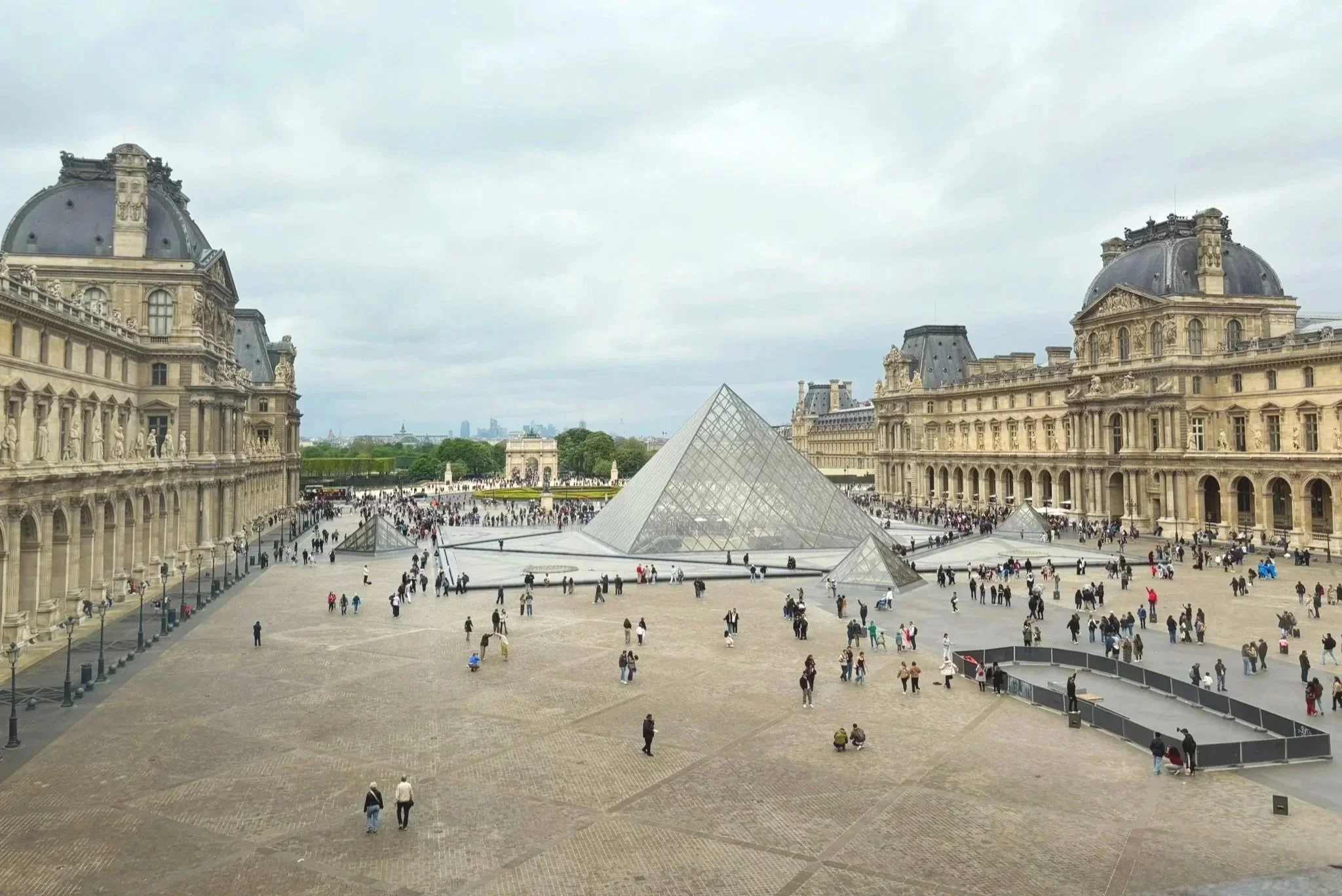
The Louvre’s famous glass pyramid was completed in 1989 and today helps one of the world’s most famous museums shuttle visitors inside in an efficient manner
Saturday, 8:21am — We sit down for breakfast at Hôtel Chavanel for the first time. I am astonished there aren’t any crepes; just literal “really thin pancakes” (which are delightful, but still).
Our third day in France was extremely top heavy, which is to say our two big to-do’s were in the morning and early afternoon. We’re talking about some heavy hitters here, too, as you may have deduced from the title of this post(card). Knowing what lie ahead, it was important to get the day started on the right foot. So, as soon as we had primped and clothed ourselves, we squeezed into Hôtel Chavenel’s tiny elevator and rode all the way down to the basement to experience their feted “American” breakfast buffet for the first time.
The decor downstairs had kind of an under-the-sea vibe, sort of like a little grotto. We didn’t find any of Ariel's gadgets, gizmos, whozits, whatzits, or thingamabobs, but there was a healthy amount of (actual) pancakes, scrambled eggs, bacon, and fruit, along with an assortment of charcuterie-style meats and cheeses, and that was just as good. Better, even, as I’m sure it would be mighty difficult to extract any nutritional value out of a gizmo or a whatzit.
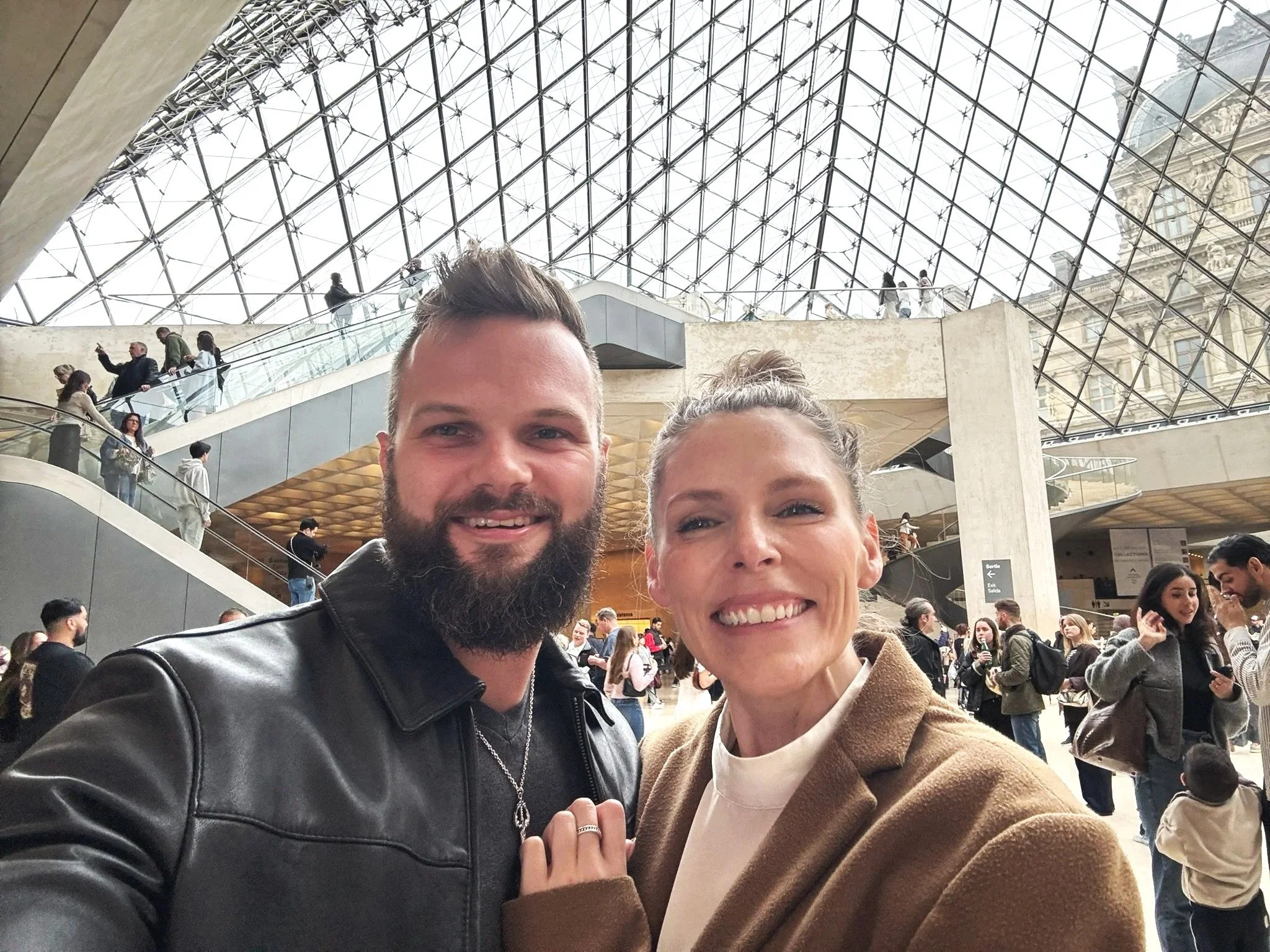
Freshly fed and caffeinated, it was time to venture over to Paris’ most famous and highly-visited museum: the Louvre. Mona Lisa’s house was only a 20-minute walk from the hotel, so I figured we had nothing to fear, right? Our timed tickets had 9 a.m. printed on them and we were going to stroll right on in, no problems whatsoever. Not so fast! We arrived nearly on the dot, but when we did, we found a line outside the entrance stretching longer than the Great Wall of China. That had us nervous, but things moved fairly quickly, and that human-made Great Wall collapsed faster than you can say “Genghis Khan” (I don’t know where these Chinese history mentions are coming from; just roll with it). It was about a half hour after we’d arrived that we finally entered the Louvre Pyramid and descended the stairs into the museum proper.
Before we go any further, allow me to inform you that the first rule about the Louvre …is that you don’t talk about the Louvre. The second rule, however, stipulates that I just made the first rule up out of whole cloth, and it should therefore be ignored entirely.
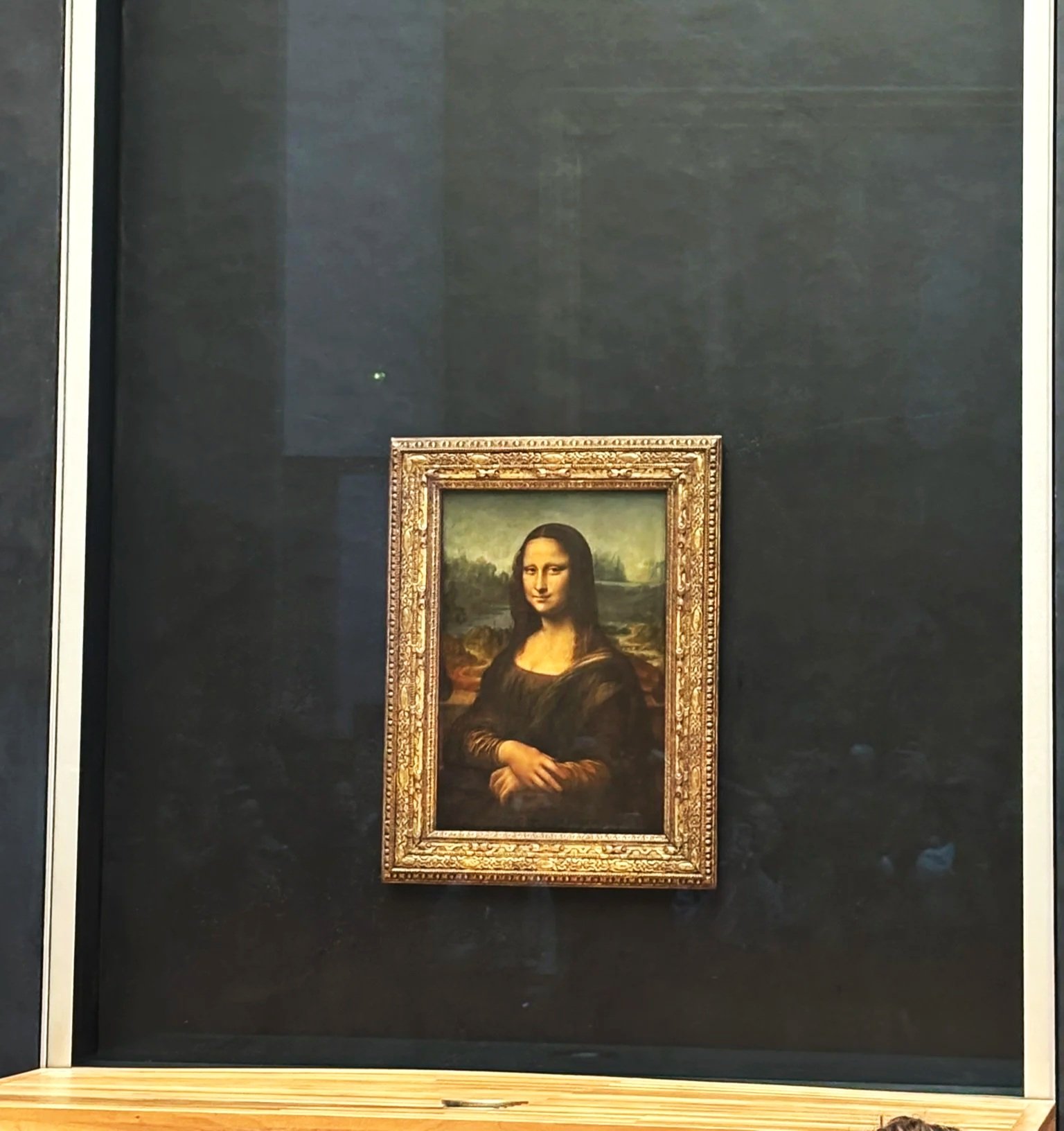
9:55am — The crowd around the Mona Lisa is already frothing. Just look at her there, watching everyone with that smug look on her face. “Yeah, that’s right, look at me, you sheep.” We are powerless to resist.
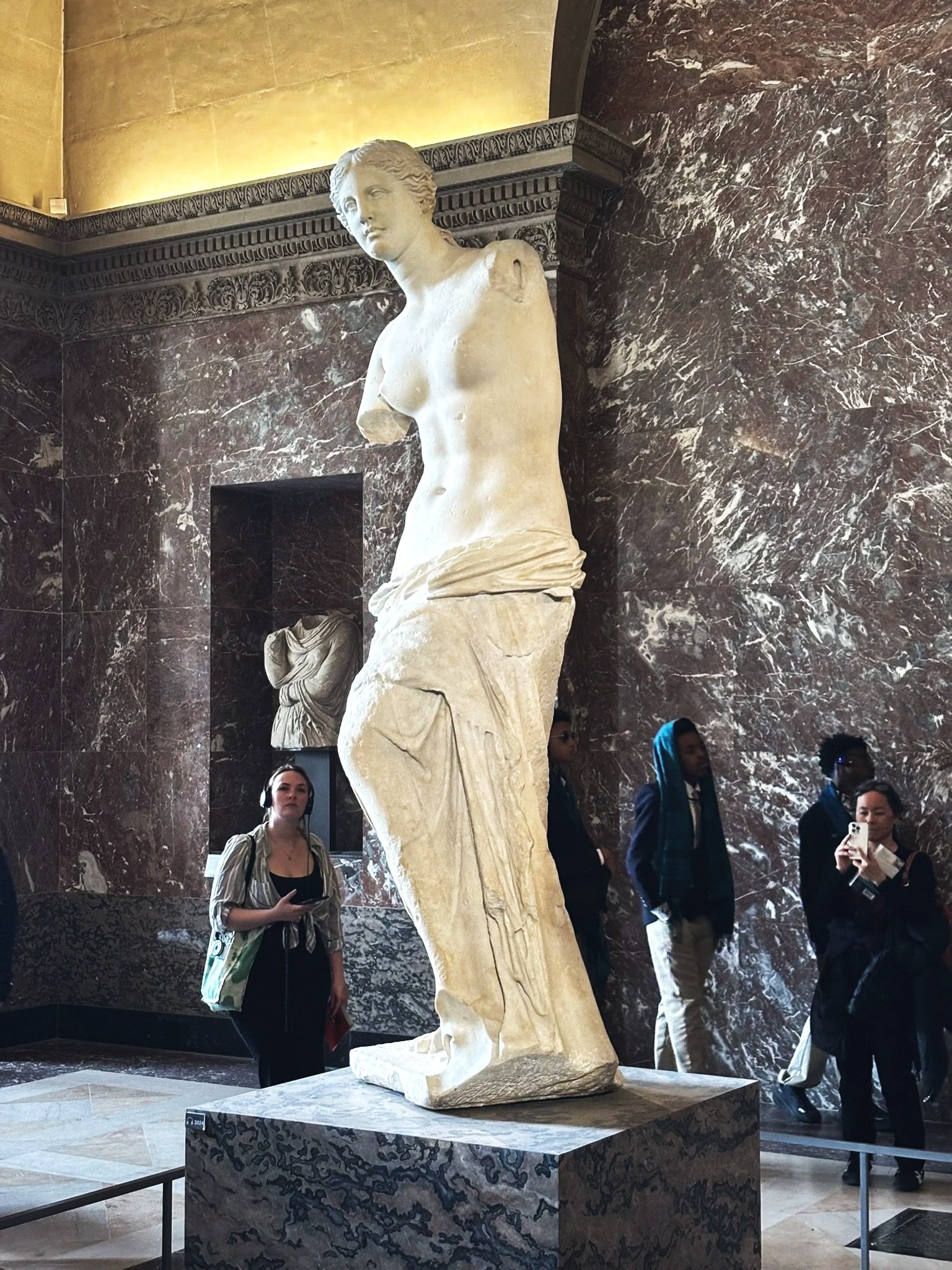
What you should know, though, is that the museum is divided into three main areas: the Richelieu Wing (decorative arts, French sculpture, Northern European art); the Sully Wing (Egyptian antiquities, Greek artifacts, French paintings from the 17th to 19th centuries); and the Denon Wing (Italian and French painting and sculpture, Roman art). Each wing has famous works of art, such as Johannes Vermeer’s “The Lacemaker” (1669-1670) in the Richelieu Wing and Alexandros of Antioch’s Venus de Milo (130-100 BCE) in the Sully Wing, but the clear front runner in terms of famous works of art is, of course, Leonardo da Vinci’s “Mona Lisa” (primarily 1503-1506).
Although the painting depicts what is now considered one of the most recognizable faces in the entire world, the inspiration for da Vinci’s masterpiece is somewhat up for debate. The leading and most widely accepted theory is that the Mona Lisa was fashioned after a woman named Lisa del Giocondo (1479-1542), a noblewoman and the wife of a wealthy silk merchant. She was identified as the woman who had sat for the famous painting a few years after she died, but it wasn’t until 2005 that a supposedly 500-year-old note written by an acquaintance of da Vinci seemed to confirm that Ms. del Giocondo was, in fact, the subject of the Mona Lisa, stating that the artist was “working on Lisa’s portrait”.
Other contenders over the years have included da Vinci’s mother Caterina, Princess Isabella of Naples, and a Spanish noblewoman named Costanza d’Avalos, among others. Another wild theory out there is that the Mona Lisa is based on da Vinci’s own likeness or that of his longtime apprentice, the fellow Italian artist Salaì, who is also rumored to have been Leonardo’s boy toy.
Whatever the case, the Mona Lisa waits for you, but so, too, does a crowd of clout-chasing posers who have to film their latest TikTok or go live on Instagram, ruining everyone else’s experience. Which is why it is recommended to get to the Louvre early, when you might — might! — be able to avoid the mindless masses.
11:33am — After a frenzied hunt, we finally lay eyes on the Venus de Milo. She looks back at us as if to say, “I’d pat you on the back, but I don’t have any arms.”
In addition to the wealth of paintings, carvings, sculptures, and what-have-you housed inside the Louvre, the structure and grounds themselves are historic in their own right. The museum complex that exists today dates back to the 16th century when Francis I tore down a fortress that had stood on the site for nearly 350 years, commissioning the construction of a Renaissance-style royal residence in its place. The renowned French architect Pierre Lescot was the initial man on the job when things got underway in the Year of Our Lord 1546, but the Louvre as we know it today would essentially be a construction site for the next 200 years (yes, you are reading that number correctly), as every succeeding monarch after our buddy Frankie the First put their own architectural touches on the place.
The Louvre remained a royal residence until Louis XIV took his ball and went home …to the Palace of Versailles a little over 10 miles away in the then-sprawling wilderness outside of Paris. Thereafter, the Louvre experienced a liminal period during which it housed various artists in residence until opening its doors as the public museum we know and love today in 1793 amid the French Revolution (1789-1799). Napoleon Bonaparte came along shortly after that and beefed up the palace once more, needing to make room for the myriad works of art he stole from places like Italy and Egypt, that little rascal.
We spent a good four hours or so wandering through the winding wings of the Louvre, getting lost, backtracking, returning to the same corridor for the umpteenth time. But it was all in good fun; after all, losing your way/yourself in an art museum — and a world-renowned one, at that — is certainly not the worst way to spend a morning. We did have to make way for the exits eventually, however, as we also had timed tickets for Paris’ most famous attraction: the Eiffel Tower.
2:16pm — We ascend to the second floor of the Eiffel Tower, packed into the elevator like a bunch of anchovies about to ransack the Krusty Krab. A bead of sweat drips down the elevator operator’s forehead. A baby cries. The wolf waits below, hungry and lonely. We all cry to the moon: “If only, if only…”
With the clouds overhead threatening to foist a second shower upon us, we climbed into an Uber (one of the only times we used a rideshare app during our entire stay in France) and left the Louvre in the rearview mirror. We had gone underground, but now it was time to climb and take in the most sweeping views the city has to offer.
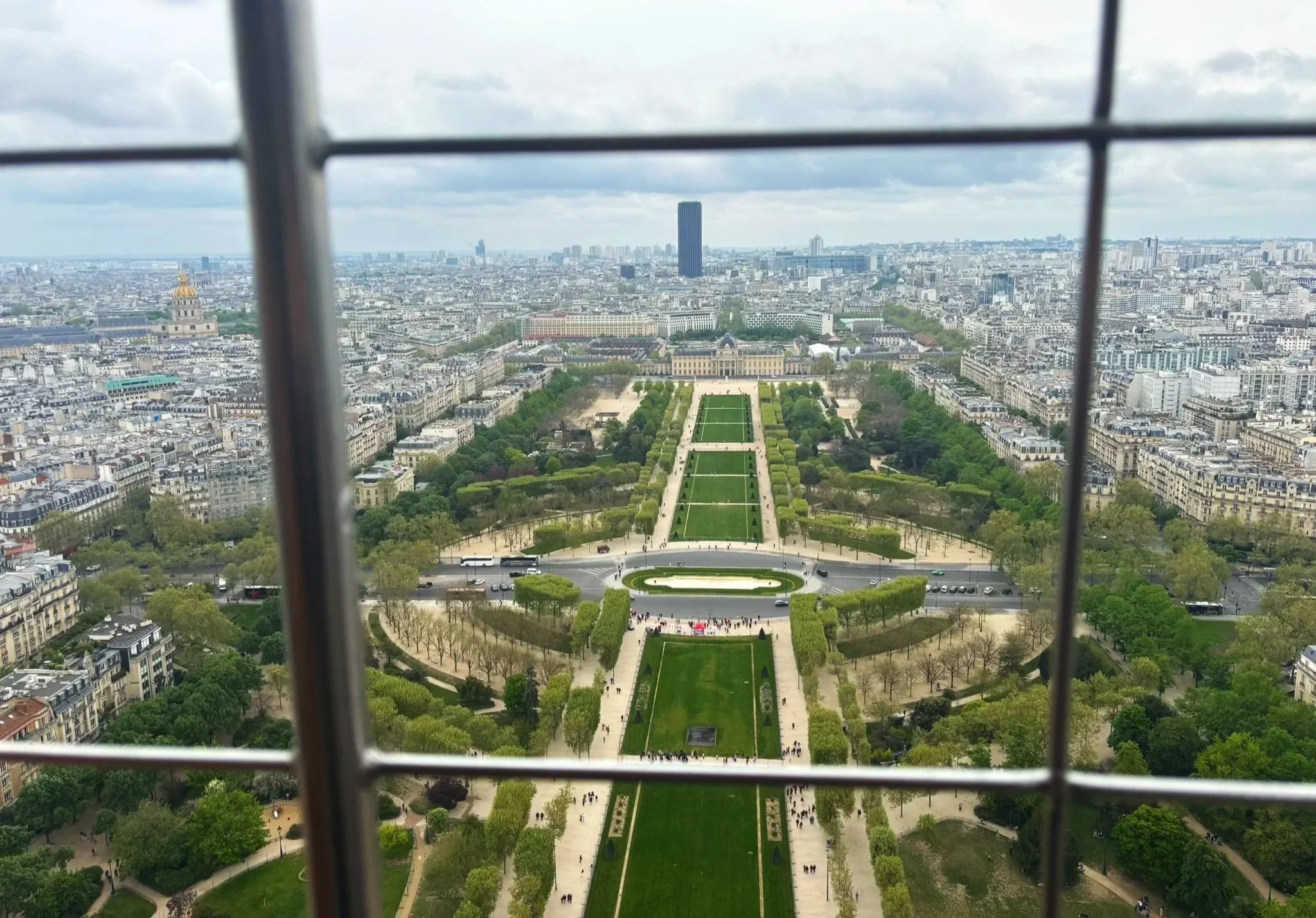
Looking southeast from atop the Eiffel Tower at the Champs de Mars stretching out before us
Built over a period of two years, two months, and five days between 1887 and 1889, the Eiffel Tower wasn’t originally meant to be a permanent French fixture. The mastermind behind the project, Gustave Eiffel, constructed the tower, which today stands 1,083 feet tall, for the 1889 Exposition Universelle — AKA the 100th anniversary of the start of the French Revolution (which we keep coming back to, don’t we?). The city granted a 20-year permit, intending to bring the whole thing down in 1909, but Mr. Eiffel had other ideas.
2:53pm — Champagne is served on top of the Eiffel Tower, because, as everyone knows, nothing beats the immortal duo of alcohol and extreme heights.
Ole Gustave, working against the forces that would see his architectural masterpiece torn asunder, turned to the magical world of science to save the day. He claimed, smartly, that his tower could be used for various scientific purposes, including meteorological and astronomical observations, physics experiments, and wind and air resistance studies, among other things. Thinking ahead, in fact, he actually installed a meteorology laboratory on the third floor of the tower the same day it was inaugurated. The Eiffel Tower’s real saving grace, however, would be the advances it helped bring about in wireless broadcasting. I mean, stick an antenna on that thing and off you go, right?! We don’t have to get into it all — and won’t — but just remember this: before video killed the radio star, the radio saved the Eiffel Tower. So, damn it, why don’t you show a little appreciation?
We stayed atop the tower for a little over an hour, taking in the view from all available vantage points and, of course, documenting our time via photo and video for posterity. It’s not exactly a visual you can grow tired of, but it’s not like we were going to break into the tiny, recreated version of Gustave Eiffel’s office and snuggle up next to the wax figures of he and Thomas Edison. Plus, we had to figure out our dinner plans, and they probably wouldn’t have been much help in that regard either.
7:20pm — Informed that the restaurant is completely booked inside for the remainder of the night, we post up at a table out front. Not three minutes later, a different member of Little Nonna’s wait staff appears and ushers us to a table just inside the door. We’re left to wonder if the hostess was simply mistaken or in the middle of a little schadenfreude-fueled power trip.
We closed out the night with some gluten-free pie at an entirely glutinous-free pizza joint just a few blocks north of the Arc de Triomphe (for more on that, take a peek back at Day 2) called Little Nonna. Despite our initial encounter with the hostess, who looked at us like a pair of bugs that must be squashed quickly (50 points to Gryffindor if you know that reference), our dinner experience was quite lovely. The ‘za was zesty, the dessert was divine, and the vibes were in vogue, at least in my estimation. Even the 45-minute walk back to the hotel was a delight, as we continued to familiarize ourselves with our Parisian surroundings. All good things, my friend.
-LTH